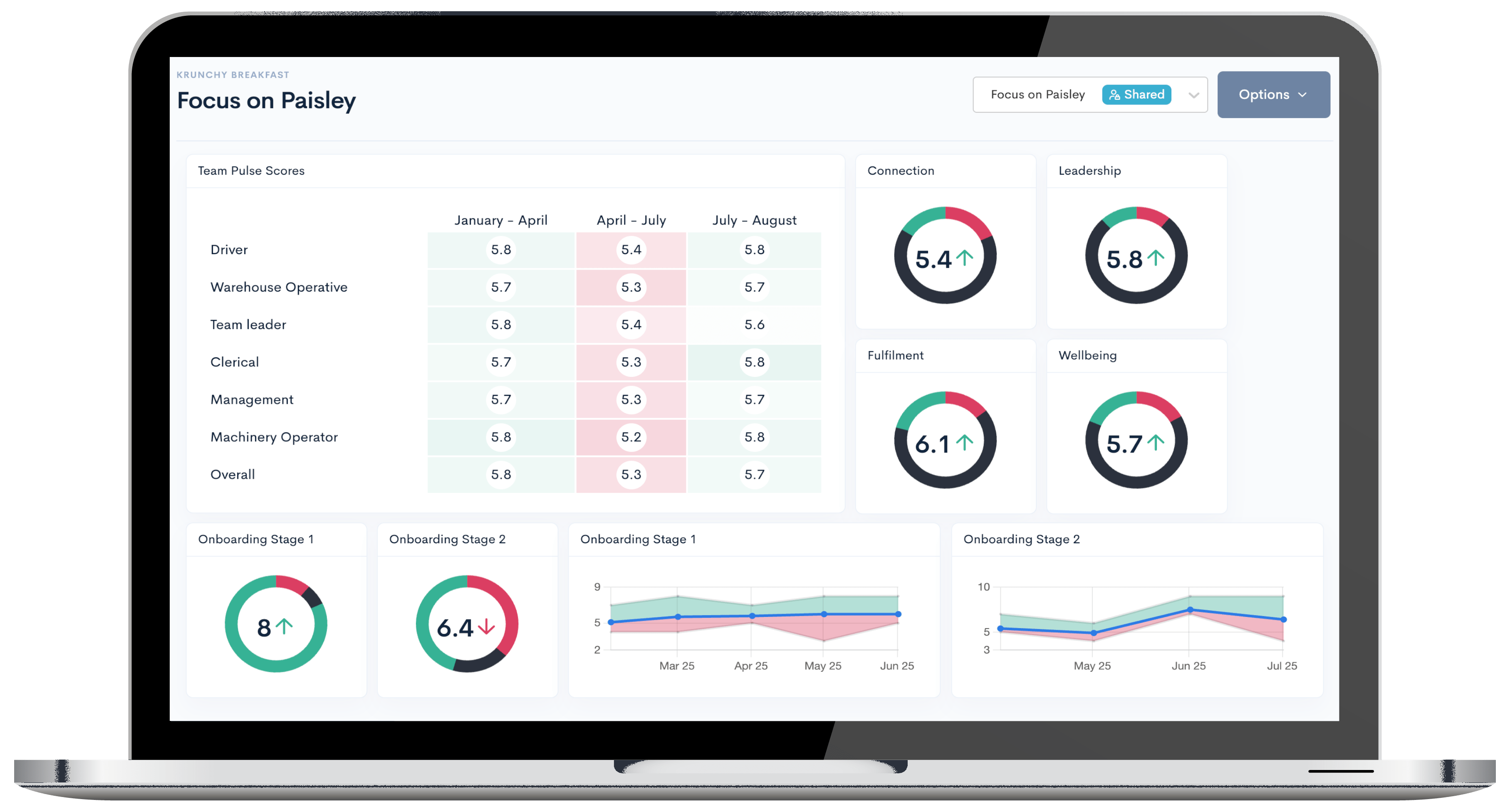
Continuous performance management connects objectives, regular conversations and feedback throughout the year, rather than relying on a single annual appraisal. Employee engagement and pulse surveys show how teams are doing, and where change may be needed. 360 feedback, appraisals and one-to-ones help people understand their own performance, behaviour and development. Connect the two through shared objectives, while keeping individual survey responses separate from personal reviews. Then listen again, to see whether the changes have made a difference.
In most organisations the two halves live apart, with different owners, tools and dates in the calendar. People are asked how things feel in the spring and how they are doing in the autumn, and what the survey found rarely shapes the objectives they work on.
Why do engagement and performance belong in one cycle?
Because they move together, and each seems to affect the other. Gallup's 2024 meta-analysis of its Q12 engagement survey covers 183,806 business and work units. Between units in the top quarter for engagement and those in the bottom quarter, it found median differences of 23% in profitability and 18% in productivity (measured by sales), in favour of the more engaged units (Gallup, The Relationship Between Engagement at Work and Organizational Outcomes, May 2024).
The CIPD adds a useful caution. Its factsheet on engagement says research has repeatedly linked engagement with higher performance, but that most studies show a correlation rather than a cause, and that engagement and performance seem to influence each other (CIPD, Employee engagement and motivation, 23 July 2025). The same factsheet reports a finding from the CIPD's Good Work Index: the quality of relationships and support from managers is consistently linked to job satisfaction, enthusiasm, effort and whether people intend to quit.
So engagement isn't a lever you pull to get performance. Clear objectives, regular conversations and managers who support their people show up in both. That is the case for managing them as one cycle rather than two projects.
What does each one tell you?
Each part answers a different question, about a different group of people.
| What it tells you | A typical rhythm | |
|---|---|---|
| Employee engagement survey | How the organisation feels, and why | Once a year |
| Pulse surveys | Whether things are changing | Weekly to quarterly |
| 360 feedback | How a person's behaviour lands with the people around them | Ad-hoc, alongside appraisals, linked to training or development programmes |
| Staff appraisal | How a person has performed against their objectives | On the cycle you choose, normally at least once a year |
| One-to-ones | What is happening now, and what help is needed | Every few weeks |
The first two are about teams; the last three are about individuals. Keeping that difference matters.
Where do surveys, 360 feedback and appraisals connect?
They connect through actions and objectives, never through any one person's survey answers. The chain runs like this:
- Survey themes. The engagement survey or a pulse shows what a team wants to change.
- Actions and shared objectives. A shared objective says what should change, with a small number of actions to get there, each with an owner and a date. They may be agreed by a team, between a manager and someone such as an HR business partner, or set elsewhere in the business.
- Personal objectives. The people who own those actions take an objective of their own. It may be for a manager, or for one or more people in a team.
- One-to-one talking points. Progress comes up in regular conversations, while there is still time to help.
- The appraisal and development actions. The review looks back at what was done, and agrees what each person will work on next.
- The next pulse. It shows whether things changed for the team, and the cycle starts again.
A worked example
Take a depot. Its pulse survey shows that people on the night shift, drivers and warehouse staff alike, don't feel their work is recognised.
- The senior leadership team agrees a shared objective: people on the night shift feel their work is recognised, with the next pulse as the check.
- The HR business partner takes an action: set up a thank-you nomination box that anybody can submit a nomination to.
- The depot manager takes an objective of their own: read out nominations at every briefing, on every shift, starting within a month of the results being shared.
- The depot manager sets a shared objective: everyone in the depot nominates at least one person each month.
-
The depot manager's 360 feedback supports their development. If it fits their development objectives, it can include a question about how consistently they recognise good work, which our 360 feedback model covers under collaboration and belonging. This gives another perspective on their behaviour, without using individual survey responses to assess them.
See 360 feedback questions for more.
-
One-to-ones keep it moving. The depot manager and their own manager, the director, talk about progress, and what help is needed.
- The depot manager's appraisal looks back over the cycle. Their objective is reviewed with a record of what was done, not from memory.
- The next pulse checks. It shows whether the night shift feels more recognised, as a team.
For help writing objectives like these, see examples of objectives and key results for common roles. In Ten Space, goals can be viewed and managed next to survey results, appraisals, 360s and one-to-ones, so an objective can sit beside the survey result it came from.
What has to stay apart?
Survey responses are for understanding teams, never for assessing a person. That rule helps keep people honest in both halves of the cycle.
If people suspect that what they say in a survey could reach their appraisal, they are less likely to say it, and the survey tells you less. Gallup's May 2024 report, The Relationship Between Engagement at Work and Organizational Outcomes, also notes that, because of confidentiality, employee surveys are reported at the level of business or work units. Continuous performance management has to keep that promise.
In practice:
- Team results can shape a manager's objectives. Never let one person's survey answers reach their appraisal, their 360 or their manager.
- Report survey results for groups, not people. In Ten Space, with the ethics filter enabled (the most common setup), results are only shown for groups of six or more.
- Set personal objectives on actions, not scores. The team's next survey result shows whether a shared objective is working, but "Raise the recognition score by ten points" as a manager's objective invites pressure on the team to answer kindly. "Read out nominations at every briefing" doesn't.
- Say what each 360 is for, and agree before you start who will see the results. It may be for development, an appraisal or a leadership programme. If a 360 is part of a performance improvement plan, describing it as development is enough: the plan itself is sensitive, and usually best kept between the person, their manager and HR. In Ten Space, 360 results are confidential, and released when you're ready, by whoever you choose: a manager, someone in HR, a coach or a consultant. Who sees what is set by permissions you control.
What does a year of continuous performance management look like?
Here is one way to lay out a performance management cycle across a year. It is a suggestion, not a fixed process: move the pieces to fit your financial year, your busy seasons and your shift patterns.
| When | What happens | What it feeds |
|---|---|---|
| Month 1 | The annual engagement survey | The themes for the year |
| Month 2 | Share the results and agree shared objectives, actions and personal objectives | Objectives everyone can see |
| Every few weeks, all year | One-to-ones | Progress, support and a record of what was agreed |
| Months 4, 7 and 10 | Pulse surveys on the themes you are acting on | An early sign of whether the actions are working |
| Month 6 | A mid-year review | Objectives adjusted to what has changed |
| Months 6 to 9 | 360 feedback, for development | Each person's development actions |
| Months 11 and 12 | The staff appraisal | A look back at the year, and objectives for the next |
| Month 13: start of the next cycle | The next engagement survey | Whether things changed, and the themes for the next year |
One thing matters more than the dates: people should hear what changed. A survey that leads to nothing visible makes people less likely to answer the next one honestly, or at all.
How do you include frontline and shift-based staff?
Reach them on the channels they already use, in both halves of the cycle. If care workers, drivers, warehouse teams and retail or hospitality shift staff can't take part in surveys, their teams are missing from the results. If they can't complete an appraisal or a 360, they are missing from the conversations that shape their development.
With Ten Space, surveys reach everyone by email, WhatsApp, SMS, QR code or even paper. Appraisals and 360s can both be completed by email, SMS or WhatsApp.
Three practical steps help:
- Hold one-to-ones when the shift allows, such as at the start of a shift or at handover, and make them part of the shift rather than extra to it.
- Look beyond line managers. One-to-ones are for any two people in a regular conversation: a manager and a member of their team, or a senior care worker and a new starter they support.
- Make it easy, and give everyone time to take part. If phones aren't allowed on the shop floor or in the work area, agree a safe place and a time when people can use one to answer surveys, complete appraisals and give feedback.
What does continuous performance management mean for the annual appraisal?
It keeps the appraisal, and stops it being the only conversation. Whether you call it a staff appraisal or a performance review, it still has a job: to look back over the cycle and agree what comes next. The CIPD puts the principle simply: "Performance management should be a continuous cycle, not an isolated event" (CIPD, Performance management: an introduction, 29 January 2026).
In a continuous approach, the appraisal becomes a summary of the cycle rather than a test of memory, with fewer surprises: objectives have been visible all year, and one-to-ones and 360 feedback have already covered progress and development.
Our guide on how to run a staff appraisal covers the conversation itself. For turning what comes out of an appraisal or a 360 into action, see employee development plans that get done.
How Ten Space helps
Ten Space is a UK-based employee survey and performance management platform.
- Surveys and performance in the same platform. 360s, appraisals, goals and one-to-ones are in the same platform as your surveys. The actions and goals that come out of survey feedback can feed into each person's goals, one-to-ones and reviews, so a review builds on what people have already told you. What carries through is those actions and goals, not any one person's survey answers.
-
See goals beside survey results. Turn what a survey found into goals for each department, team and person, each with a red, amber or green status anyone can read at a glance. Goals can be viewed and managed next to survey results, appraisals, 360s and one-to-ones.
See goals and objectives for more.
-
Act on what you hear. AI analysts specific to your sector, configured for your organisation, suggest prioritised actions you can accept, assign or ignore. The decisions stay with you. Give each action an owner and a due date. Reminders go out automatically, and progress is tracked for you.
See action planning for more.
-
Your model, or ours. Use our engagement model, or measure against your own company values. For 360s, use our 360 feedback model and questions, or your own model, values and questions.
- Start where you are. You can start with surveys and add 360s, appraisals, goals and one-to-ones later.
- A partner, not a supplier. We set the platform up for you, and expert help, training and support are always included. Every client has a dedicated client success manager: a named UK-based expert who works alongside your team.
See performance management in Ten Space for more.
Frequently asked questions
Is continuous performance management the end of annual appraisals?
It doesn't have to be. The appraisal can stay, as the point where you look back over the cycle and agree what comes next, but it stops being the only conversation.
How often should we run pulse surveys?
Often enough to see change, and no more often than you can act and report back. A short pulse survey typically runs anywhere from weekly to quarterly.
Should a manager's objectives include their team's survey results?
Team results may inform a manager's objectives; individual answers never do. Set the manager's own objective on what they do, not on the team's next score. With the ethics filter enabled (the most common setup), results are only shown for groups of six or more.
Can we start with surveys and add performance later?
Yes. With Ten Space, you can start with surveys and add 360s, appraisals, goals and one-to-ones later.
See the whole cycle in one place. Book a 30-minute demo.
Hear everyone. Grow together.