Choose which cookies we may use. You can change your mind at any time on our Cookies page.

Read our cookie policy

Staff surveys and appraisals for care, because your people are your service.

In care, the quality of what service users receive depends on the people who provide it. Ten Space brings staff surveys and appraisals together for care homes, nursing homes, home care, supported living and children's services, so you can hear every carer, wherever they work, keep the good people you have and help them grow.

Why does staff experience matter so much in care?

Because it makes good business sense: in care, your staff are the service. In English care homes, research using national staffing data and CQC ratings found that better staff retention and fewer vacancies go with better-rated care, and Skills for Care's analysis of around 7,100 services links higher CQC scores with more staff per bed, better pay, more training and more experienced registered managers.

Keeping and attracting carers is hard. The work is physically and emotionally demanding and often poorly paid: Skills for Care put median pay for care workers at £12.60 an hour in March 2026, 39p above the National Living Wage, and counted around 320,000 people leaving their jobs in adult social care in 2025/26.

Ten Space helps you hear from every carer, see where support is needed, home by home, and give people the supervision, appraisals and development that help them stay.

A smiling carer in uniform

How does listening to staff help you meet your obligations?

Inspectors look at the things your staff live with every day. Whether you answer to the CQC, the Care Inspectorate, Care Inspectorate Wales, the RQIA or Ofsted, they look at how services are staffed and led. The CQC expects staff to receive effective support, supervision and development, and its own inspectors name leaders not listening to staff, or not acting on their feedback, among their key concerns.

From 30 October 2026, employers must also take all reasonable steps to prevent sexual harassment of their staff, and must not permit harassment by third parties, such as the people they support and their families.

With Ten Space, what your people tell you, and what you did about it, is kept in one place, home by home: each action stays linked to the result it came from.

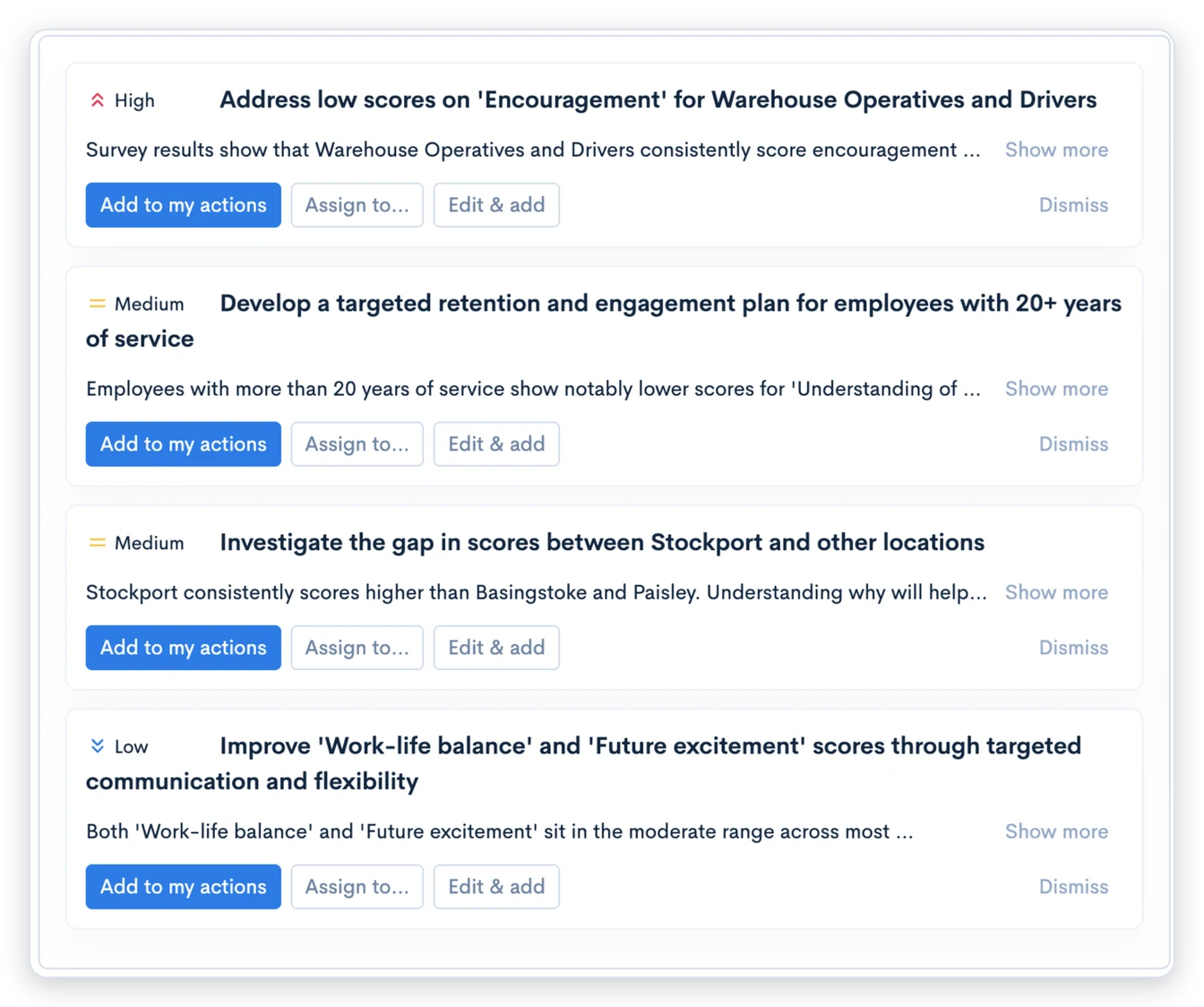
Prioritised suggested actions for a demo survey in Ten Space, each of which you can accept, assign or ignore

How do you hear from busy carers who are seldom at a desk?

Care teams are spread across homes and branches, on shifts round the clock, or out on visits, so a survey sent to an inbox misses most of them. Carers can answer in WhatsApp or by SMS, one question at a time, between visits or on a break, or scan a QR code in the staff room. People scan the code or follow the link to take part. For anyone who would rather write, we share paper forms for you to print. Scanned forms are read automatically.

Offering more than one way to answer matters: a meta-analysis of 114 experiments found that web surveys get response rates about 12 percentage points lower than other ways of asking, and in another study SMS invitations worked better than email for surveys answered on a phone.

Invitations and reminders go out automatically, and people who have already answered aren't chased. Surveys run in over 100 languages. Surveys can be run in many different languages, but not all are available with WhatsApp.

See reach every employee for more.

A care worker in scrubs reading a message on a phone

How do you support carers to develop and stay?

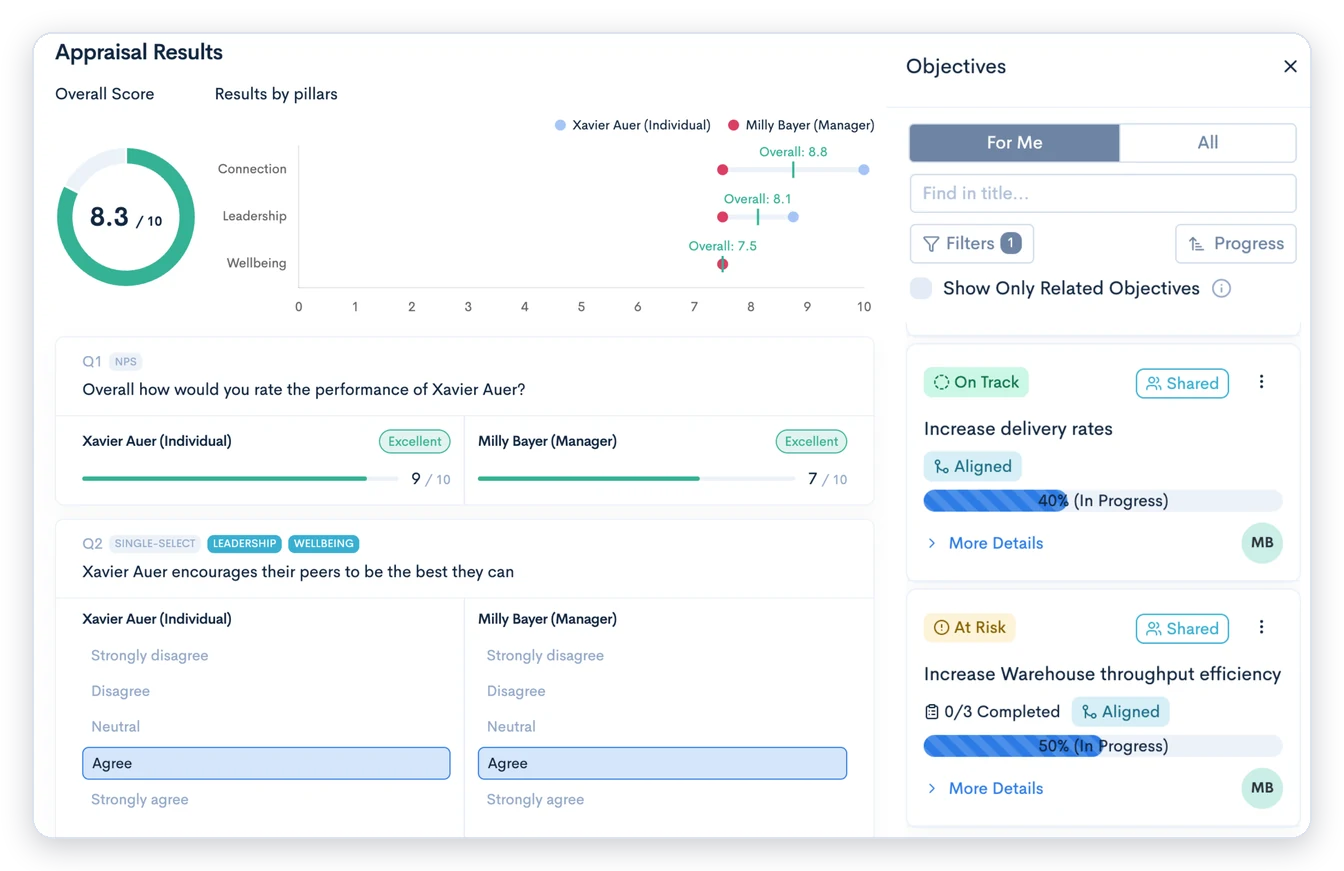
With supervision, appraisals and development in the same platform as your surveys. Appraisals run on templates your HR team controls, on a cycle you choose, ad hoc or both, with the gaps between self and manager reviews highlighted. One-to-ones give the two people in any regular conversation a shared agenda, with notes and actions kept against every talking point. With the WhatsApp or SMS add-on, people can complete their part in the chat, question by question, so staff with no work email take part too.

It matters in care: only 69% of care staff in the Department of Health and Social Care's survey of the adult social care workforce in England had an appraisal in the past year, against 85% in the NHS, and those who saw career opportunities in their organisation were more likely to be with the same employer two years later. Skills for Care found that care workers with training recorded had lower turnover, 23.0%, than those with none, 31.5%.

Ten Space's questions for care are ready for appraisals and one-to-ones, and the goals and actions that come out of a survey carry through to each person's reviews, so supervision builds on what carers have already told you.

See performance management for more.

An appraisal in Ten Space with demo data: the employee's and the manager's answers side by side, with the employee's objectives

Care staff survey questions, by issue

The questions are where it starts: they show you where to act. Each group below begins with what research on care has found, says what the questions help you see and how to track them, then gives the questions in a box. Statements are answered on a scale from strongly disagree to strongly agree.

The first question in each box is the core question for that issue. Keep it the same from one survey to the next: research on measuring change over time shows that comparisons only hold when the question stays the same. Use the rest as they are, add your own, or ask us: we work with you to fine-tune your questions.

Turnover and retention

Will new carers stay past their first year?

Skills for Care's 2026 workforce report puts care worker turnover in England at 28.2%, and at 33.7% among care workers in their first year in the role, against 12.6% for those with 20 years or more. A quarter of the staff in DHSC's survey of care staff in England said they would leave as soon as they found another job. Research on new starters finds that knowing what is expected, feeling confident in the job and feeling accepted by the team help people settle and stay.

What it helps you see: who is thinking of leaving in their first months, and whether induction, shadowing and the first rotas are working.

Questions to ask

  • I see myself still working here in a year's time.
  • My induction prepared me for the work I do.
  • I had enough time shadowing experienced colleagues before I worked on my own.
  • I feel accepted by the team I work with.
  • What would make you more likely to stay?

How to track it: ask the core question in every survey, and follow new starters with an onboarding journey, with check-ins such as 30, 60 and 90 days after they join. Compare homes and branches on a dashboard to see where people leave soonest.

Workload and staffing

Do carers have time to care?

In DHSC's survey of care staff in England, 40% of staff said they did not have enough time to do the job well within their paid hours, rising to 56% in residential care, and 24% of staff in home care and similar services reported too little or no pay for travel between visits. Skills for Care found that the care homes with the highest CQC scores had a median of 1.50 staff per bed, against 1.26 at the lowest-scoring.

What it helps you see: where shifts are short-staffed, where care feels rushed, and in home care whether rotas leave realistic, paid time to travel.

Questions to ask

  • I can usually get my work done well in the time I have.
  • There are enough staff on my shifts to give people the care they need.
  • My rota gives me enough time to travel between visits.
  • What gets in the way of giving good care?

How to track it: run a short pulse survey on a schedule you set, split by home, branch and shift, and set the answers beside your rotas and staffing.

Burnout and wellbeing

Are carers running on empty?

Stress and burnout were the most common reason care staff gave DHSC's survey for thinking of leaving, named by 60%, ahead of low pay at 54%. In a study of 2,062 UK care home staff, 29.5% had high burnout, and younger staff, staff with English as a second language and staff who worked only nights were at higher risk.

Whether carers can afford to stay at home when they are ill matters too: in English care homes early in the COVID-19 pandemic, paying staff sick pay was linked to less infection among staff.

What it helps you see: who is most stretched, by role, shift and home, and whether people can rest, take their breaks and get support after a hard shift.

Questions to ask

  • I have enough energy left for life outside work.
  • I can take my breaks, even on busy shifts.
  • I can get support after a difficult or upsetting shift.
  • I can afford to stay off work when I'm ill.

How to track it: ask in a pulse survey every month or quarter, and split the results by shift, so you can see whether nights differ from days.

Safety · Lone working

Do carers feel safe, in the home and on visits?

41% of the care staff in DHSC's survey had been physically assaulted by someone they care for or support in the past year: 59% in residential care and 29% in home care. Home carers often visit alone, and HSE says employers must manage the risks before anyone works alone.

What it helps you see: where aggression happens, whether staff feel supported afterwards, and whether people working alone know how to get help.

Questions to ask

  • I feel safe at work.
  • I know what to do if someone I support becomes aggressive.
  • After an incident, I get the support I need.
  • When I work alone, I know how to get help quickly.

How to track it: ask in every pulse survey and report care homes and home care separately. An alert tells the right person that an answer needs attention.

Discrimination, harassment and inclusion

Is every carer treated with respect?

The same survey found that 39% of care staff had faced harassment, bullying or abuse from the people they support in the past year, 23% from colleagues and 22% from managers. Among local authority care staff, Skills for Care found that colleagues from the global majority reported 48% higher rates of harassment, bullying or abuse from colleagues than white colleagues, and a review of UK research found wider inequalities in recruitment, progression and treatment at work.

The CQC was told of 787 services losing their licence to sponsor overseas workers in 2025/26, most for paying incorrect salaries.

What it helps you see: whether carers from every background are treated fairly by the people they support, families, colleagues and managers, and whether they feel able to say so.

Questions to ask

  • I am treated with respect by the people I work with.
  • When someone I support or their family is abusive, my manager backs me.
  • People here are treated fairly whatever their background or where they come from.
  • If I had a problem with my contract, pay or visa, I would know who to ask.

How to track it: split results by role and, where groups are big enough, by background, with the ethics filter on so results are only shown for groups of six or more.

Management and support · Training and progression

Do carers get the support and training to grow?

Skills for Care found care worker turnover of 28.3% where the registered manager had been in post for less than a year, against 20.6% where they had been in post for 20 years or more. Research across sectors finds that support for development keeps people only when they can also see a way to progress where they are.

What it helps you see: whether supervision and training reach every carer, which homes have the leadership to keep people, and whether carers can see a future with you.

Questions to ask

  • My manager supports me when I need it.
  • I have regular supervision that helps me do my job.
  • I have had the training I need to do my job well.
  • I can see a way to progress here.

How to track it: compare homes and branches on a dashboard, especially after a change of manager, and bring what you learn into supervision and appraisals.
How do you track staff experience across homes and services?

Ask the same core questions in a short pulse survey, normally fewer than ten questions, on a schedule you set. It can repeat automatically, so you can see whether a new rota or a new manager has helped.

Follow new carers through their first months with an onboarding journey, with check-ins such as 30, 60 and 90 days after they join, and ask leavers why they went with an exit survey. These are surveys like any other: they go out automatically, by email, WhatsApp or SMS.

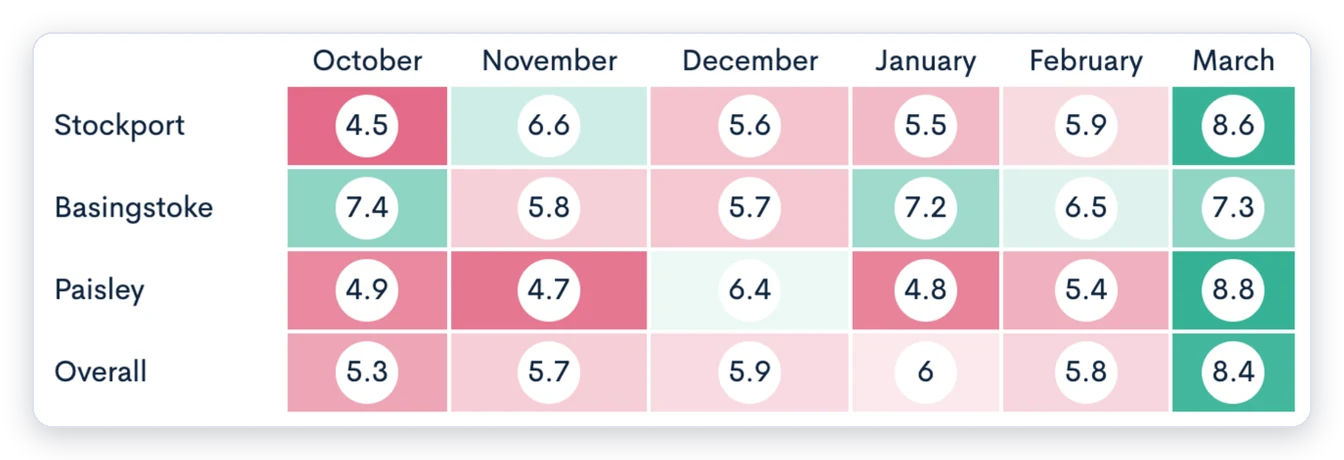
Compare homes, branches, services, shifts and roles side by side on dashboards for care, from day staff to night staff. AI analysts specific to your sector, configured for your organisation, summarise every survey, team and question, and suggest prioritised actions you can accept, assign or ignore. The decisions stay with you.

Then show carers what changed. Research on employee surveys found that people who don't answer are more likely to be planning to leave, and to believe nothing is done with the results.

Turn what you hear into actions, each with an owner and a due date, linked to the result it came from. Reminders go out automatically, and progress is tracked for you.

A heatmap of demo results in Ten Space, comparing three sites month by month

What does Ten Space do for care providers?

It brings staff surveys and appraisals together in one platform, with UK-based experts alongside you.

  • Hear from every carer, on shift, on nights or between visits, by email, WhatsApp, SMS, QR code or even paper.
  • Spot new carers at risk of leaving, with onboarding check-ins such as 30, 60 and 90 days after they join.
  • See staffing pressure, wellbeing and safety home by home and shift by shift, on dashboards for care.
  • With the WhatsApp or SMS add-on, run appraisals that carers can complete on their phones.
  • Turn what you hear into actions, with reminders that go out automatically.
  • Work with a dedicated client success manager: a named UK-based expert who works alongside your team.
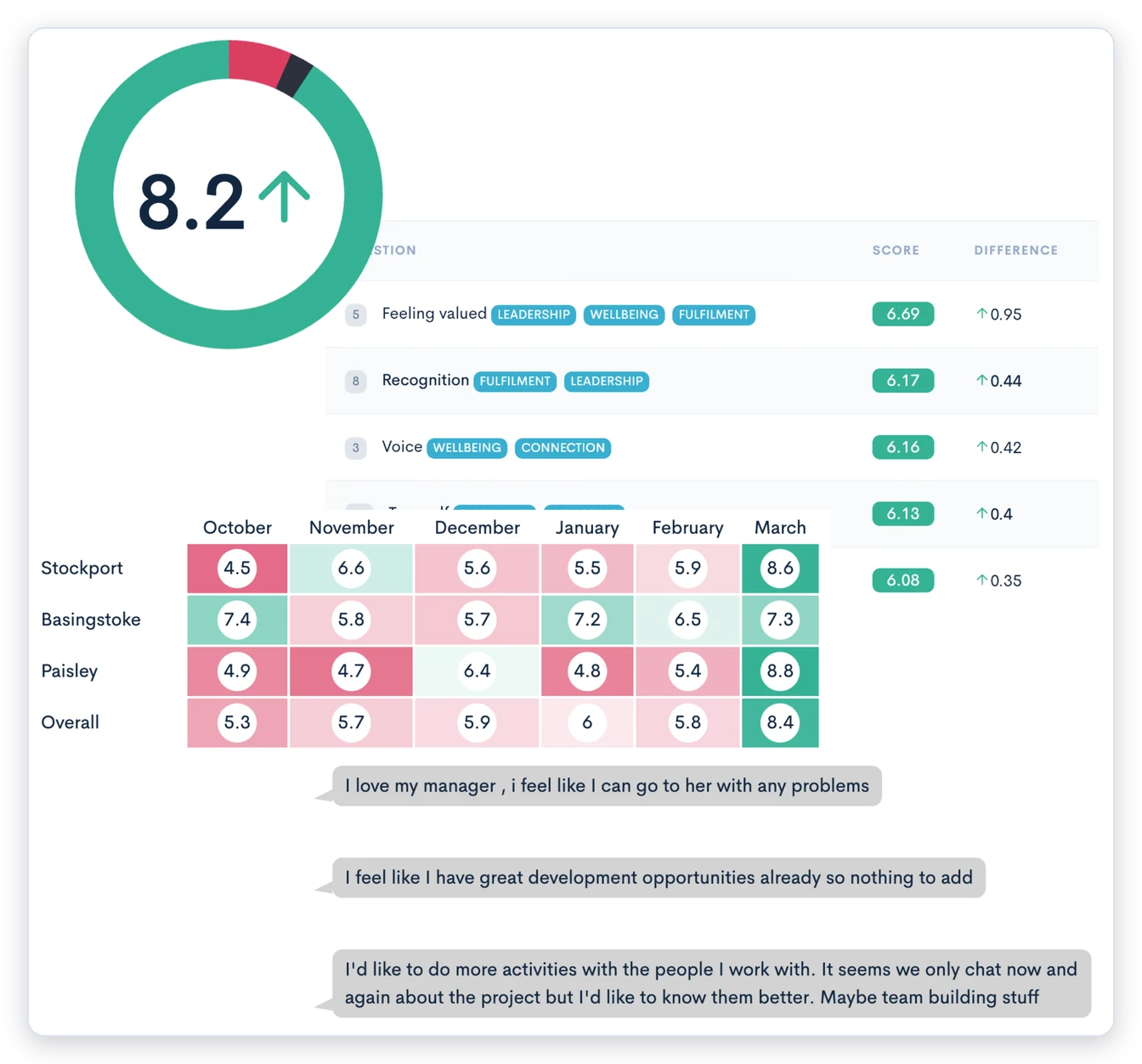
A Ten Space dashboard with demo results: a headline score, question scores, a heatmap by site and comments

Questions people ask

How often should a care provider survey its staff?

Often enough to act on what you hear. You might run a fuller survey once or twice a year, a short pulse survey in between, and an onboarding journey and exit survey as people join and leave. There is no fixed rhythm: we help you choose one that fits.

Can carers answer without a work email address?

Yes. They can answer in WhatsApp or by SMS, by scanning a QR code, or even on paper. No work email address is needed.

Can carers complete their appraisals on a phone?

Yes. With the WhatsApp or SMS add-on, people can complete their part in the chat, question by question, so staff with no work email take part too. Goals and one-to-ones sit in the same platform, so supervision builds on what carers have told you.

Will care staff answer honestly?

People answer more openly when they trust how their answers are used. With the ethics filter enabled (the most common setup), results are only shown for groups of six or more. Everyone sees what their role allows, and only that. Telling people what changed after each survey builds that trust.

Does Ten Space have staff survey questions for care?

Yes. Ten Space has questions specific to your sector for surveys, journeys, appraisals and one-to-ones, and dashboards for your sector for surveys and journeys. Use them as they are or add your own, and we work with you to fine-tune your questions.

Is Ten Space only for care homes?

No. It works for care homes, nursing homes, home care, supported living and children's services, wherever your people work. Every survey can be split by any segmentation item, such as home, branch, service, shift or role. Paper, open-link and QR-code surveys are pre-tagged with as many segmentation options as you need.

Sign up for our regular round up