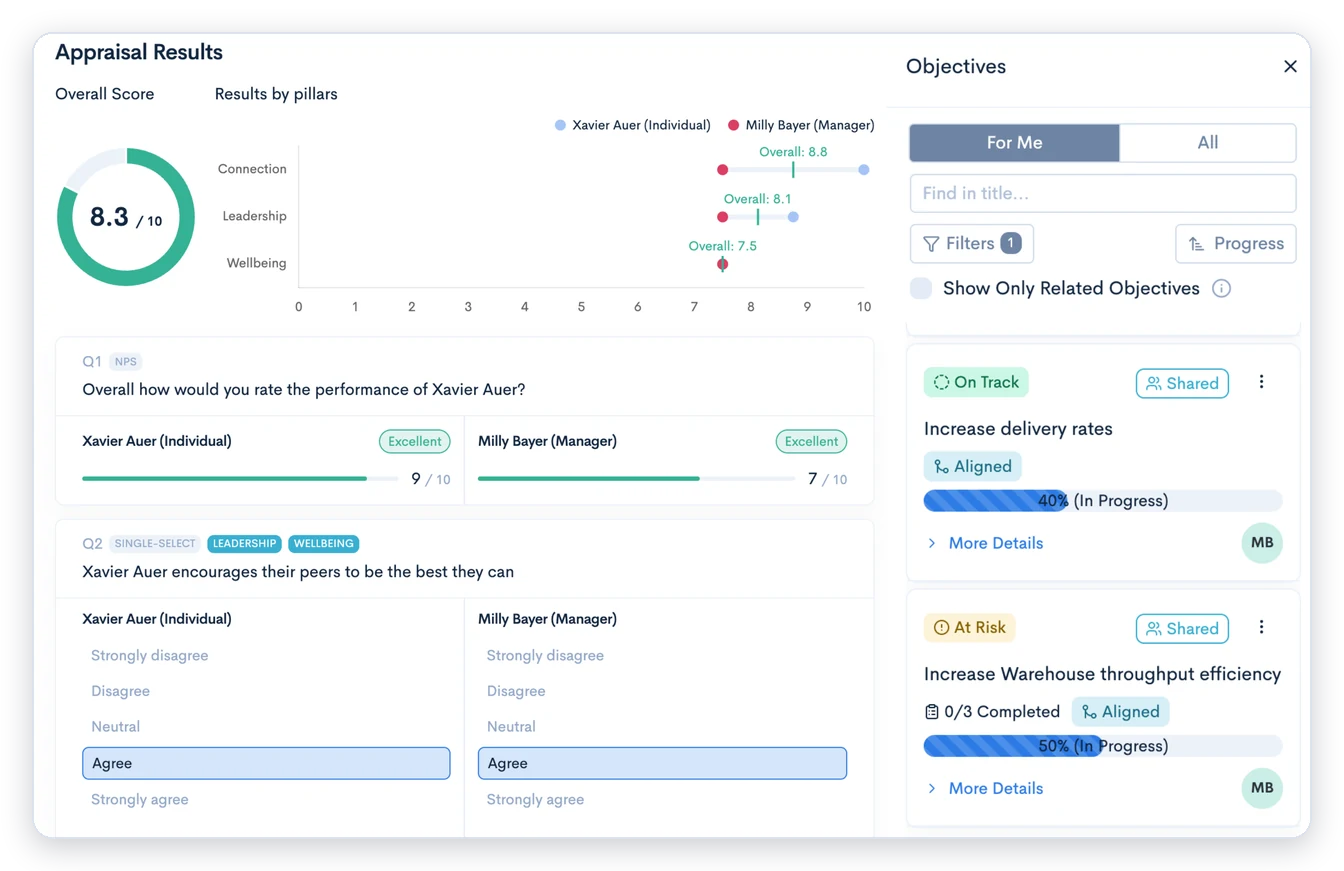
A staff appraisal is most likely to help people grow when it looks back over the whole year, applies the same standards to everyone in a role, and ends in agreed objectives, actions and support rather than just a score. To run one well, look back over the year together, ask the person for a self-review and the manager for their own, compare the two, talk most about where they differ, and agree what happens next. This guide takes you through each step, with staff appraisal questions you can use and advice for teams who don't work at a desk.
What is a staff appraisal?
A staff appraisal is a regular, structured conversation between a person and their manager about their performance, their development and their objectives. Many organisations hold them once a year, often with a shorter mid-year review.
Acas describes appraisals as a chance to talk about what someone is doing well, where they could improve, whether they need more support or training, and their career (Acas, Performance management: reviews and appraisals, 23 June 2026). A good appraisal covers all four, and the person leaves knowing what is expected of them and what help they will get.
Why do some staff appraisals fall short?
Staff appraisals can fall short when they feel like a tick-box exercise, or when one meeting is expected to cover a whole year with too little evidence or follow-up.
- It feels like a tick-box exercise. An appraisal has to be worth something to both the manager and the employee. If either of them sees no value in it, neither will engage with it properly.
- The last month counts most. In an annual appraisal, recent events can crowd out everything before them.
- It rests on one person's view. A manager may see little of the work, especially on nights, on the road or at another site.
- Nothing links it to objectives. If last year's objectives were never looked at again, there is nothing to measure against.
- The form is filed and forgotten. Actions agreed in the appraisal may not be looked at again until the next round.
- Standards differ from one manager to the next. One manager's "meets expectations" can be another's "exceeds", and people notice.
The CIPD's factsheet on performance management describes a shift away from annual appraisals, towards more regular reviews and better conversations (CIPD, Performance management: an introduction, 29 January 2026). That needn't mean scrapping the appraisal, but it should sum up conversations held all year.
How should you prepare for a staff appraisal?
Both people look back over the year, each completes their own review, and the manager brings the two together into talking points for the appraisal one-to-one.
- Look back at objectives and actions. Both people go through what was agreed, what changed and what got in the way.
- Read back through one-to-one notes. Both look at what came up in their one-to-ones, what was agreed and what support was given.
- The employee completes a self-review, a week or so before the appraisal one-to-one.
- The manager completes their own review, independently. It draws on the year's evidence and any 360 feedback, and gives the manager's own view, not a reply to the self-review.
- The manager compares the two. They note where the views agree and where they differ, and pick out examples of each, good and less good. The next section says what a gap may mean.
- Organise it into talking points. Gather it all, ready for the appraisal one-to-one, with talking points to discuss, so both people know what the conversation will cover.
In Ten Space, an appraisal can be a self-review plus a manager review, with goals alongside the review. A one-to-one can be a step in the appraisal, with a shared agenda of talking points.
What is the perception gap?
The perception gap is where a person's view of their own work and their manager's view differ. It shows where the conversation needs to go.
- Where both agree something went well, say so and move on.
- Where the person rates themselves lower, they may not know their work is valued. Tell them, with examples.
- Where the person rates themselves higher, expectations may not have been clear, or the manager may not have seen everything. Ask what their view is based on before you give yours.
For example, a care home team leader might rate her planning as weak while her manager rates it as strong, because she kept every shift covered through a winter of sickness. That gap is the conversation: she may not know her work has been seen.
A perception gap isn't a verdict on who is right. It is a signal to explore what sits behind the difference: expectations, evidence, feedback, support or how well the manager has seen the work. Both views deserve to be heard before agreeing what happens next.
Ten Space highlights the gaps between a self-review and a manager review, so that your team can make sure everybody gets the support they need to grow.
What staff appraisal questions should you ask?
Ask questions that cover the whole year and the year ahead. Choose a few from each set below, ask everyone in the same role the same core questions so that answers can be compared fairly, and use fewer for frontline roles.
Self-review questions
- What are you most proud of since your last appraisal?
- Which of your objectives went well, and which didn't? What got in the way?
- When did you help a colleague, another team or the people you serve?
- What would you like to get better at over the next year?
- What training, support or equipment would help you do your job better?
- Is anything making your work harder than it needs to be, such as rotas, tools or processes?
- What should your manager start, stop or keep doing?
- Where would you like to be in two or three years?
Questions for the manager's review
- Which objectives were met, partly met or missed, and what is the evidence?
- What are this person's main strengths, with an example of each?
- Where could they improve? Is it a question of skill, knowledge, resources or clarity?
- How have they shown the organisation's values in their work?
- Did they get the support agreed at their last appraisal? If not, why not?
- What one change would make the biggest difference to their work next year?
Questions for the conversation
- Where do we see things differently, and why?
- What did you need from me this year that you didn't get?
- What does good look like in your role over the next six to twelve months?
- Which objectives matter most, and how will we know they're on track?
- What will each of us do before our next one-to-one?
How do you run the appraisal one-to-one meeting?
Book enough time somewhere private, and work through five stages: look back, look forward, development, support, then agree actions and objectives. Cover every talking point you prepared, and let the person do most of the talking.
- Look back. Start with what went well. Then go through each objective, using the evidence you gathered, and spend most time where the two reviews differ.
- Look forward. Talk about what is changing in the team next year, and what good will look like in the role.
- Development. Ask what the person wants to learn or do next, and talk through how they could get there.
- Support. Ask what they need from you: training, time, equipment or clearer priorities. Agree what you will do, not only what they will.
- Agree actions and objectives. End with a small number of objectives and actions, each with an owner and a date, and agree when you will next talk about them.
Cover every talking point. Go through each one you prepared, so that what you spotted beforehand, such as a gap between the reviews or a stalled objective, isn't missed. If one has to wait, agree when you will come back to it.
Discuss the evidence before you settle on a rating, if you use one, so the conversation stays on the work, not on a number.
How do you make staff appraisals fair and consistent?
Keep an accurate record, check results across teams before they are shared, and give people a clear way to disagree.
- One template for each kind of role. Everyone in a role is judged against the same standard. Different roles can have different standards: what good looks like for a delivery driver isn't the same as for a finance manager. Follow-up questions can still reflect the person's circumstances, such as a change of role, a heavier workload or time away from work.
- Notes both people can rely on. Take notes during the conversation and, before you finish, check together that the key objectives, actions and points each of you raised are written down. Then they can be followed up and tracked through the year.
- Moderation. Before results are released, HR and senior managers review ratings across teams against the evidence and the agreed standards, and agree any changes. The aim is to apply the standards consistently, not to adjust ratings to fit a set quota. Note every change and the reason for it.
- Results by team on a heatmap. A heatmap can show where one team's results stand out. A team where everyone "exceeds", beside a similar team where nobody does, is worth looking into. It doesn't prove that a manager is applying the standards inconsistently: the difference may reflect the roles, the workload or genuine differences in performance.
- Release and sign-off. Share each appraisal only once it has been checked, and ask both people to sign it off, so there is one final version. Make clear that signing confirms the review has been received and discussed, not that the employee necessarily agrees with the assessment, and give them space to add their own comments.
- A way to disagree. Before the round starts, tell people what they can do if they disagree with their appraisal, and who will look at it.
What happens after the staff appraisal?
The appraisal starts the next year rather than closing this one. Within a week or so, share a written summary, confirm the objectives and actions, and book the next one-to-one.
- Write it down and share it. "It's important to keep a written record of what is discussed," Acas says in the same guidance, and that record should be shared with the employee afterwards. Ideally, hold it in a tool that keeps it organised for the next appraisal. In Ten Space, every review, goal and conversation is kept in one place, so next year's appraisal draws on the person's full history, not on memory.
-
Agree actions for both people. Actions are tactical: short-term steps, each with one owner and a due date. The employee's might be a course or a new way of working to try. The manager's might be arranging training, making time or removing a blocker. Development points become actions too.
See employee development plans that get done for more.
-
Link the actions to objectives. Objectives are strategic: the longer-term outcomes the actions serve, often over six months or a year. Write each one as an objective with key results (an OKR): a short statement of what should be different, with two or three measures that will show it has happened.
For example, a warehouse team leader's objective, with the actions both people agreed, might look like this:
Objective: orders picked on the night shift are right first time, in support of the site's accuracy objective.
- Key result: picking errors on the night shift fall from [baseline] to [target] per thousand picks within six months, measured by the weekly error report.
- Key result: the shift's pick rate stays at or above this year's level over the same period.
- Actions: the team leader coaches each new starter on the shift through their first two weeks. Their manager arranges refresher training for new starters within a month, and time with the day shift leader to compare methods.
- Owner and review: the team leader, reviewed at each monthly one-to-one and in full at the mid-year review.
See examples of objectives and key results for common roles for more.
Come back to the objectives and actions in one-to-ones through the year. Acas advises managers to keep talking to people about their work between formal reviews, through feedback, coaching and regular check-ins.
See how surveys, 360 feedback and appraisals work together for more.
How do you run staff appraisals for frontline and shift-based teams?
Keep them short, set standards that fit each role, and let people take part from wherever they work. A care worker on nights, a delivery driver or a warehouse picker may have no desk, no work email and no spare hour in the middle of a shift. A process designed for the office can leave them out.
- Use a shorter template. Five or six questions that matter for the role beat twenty that don't.
- Set standards that fit the role. Judge a retail or hospitality shift manager on what the role needs, such as safety, reliability, teamwork and the service people receive, not on office measures.
- Let people complete their self-review on their phone. In Ten Space, appraisals can be completed by email, SMS or WhatsApp, so people without a desk or a work email can take part.
- Protect time for the conversation. Schedule it within working hours, somewhere private enough to talk openly, and arrange cover so the person isn't called away. Don't add it to the end of an already long shift.
- Ask the people who see the work. If the manager rarely works the same shift, ask the shift leaders who do, or run a 360.
How Ten Space helps
Ten Space is a UK-based employee survey and performance management platform.
- Your process, your standards. Your HR team controls the templates: the questions, the timings and who needs to take part. Run appraisals on a cycle you choose, ad hoc, or both, with more than one standard where your roles need it.
- The review itself. A self-review only, or a self-review plus a manager review, with the gaps between the two highlighted. Goals alongside the review, and a one-to-one as a step if you want one.
- Help with what comes next. AI support suggests prioritised actions from each review, which you can accept, assign or ignore, and talking points for the one-to-ones that follow. The decisions stay with you.
- Fair, and on the record. Anyone who disagrees with their appraisal can dispute it, and the dispute follows a tracked escalation process. Moderation, with every score change logged, and release and sign-off. All activity is tracked.
- An overview for leaders and HR. See where every review stands, with appraisal results by team on a heatmap.
-
Part of one platform. Goals can be viewed and managed next to survey results, appraisals, 360s and one-to-ones.
See goals and objectives for more.
Our experts help your HR team to build the templates you need. We set the platform up for you, and expert help, training and support are always included. Every client has a dedicated client success manager: a named UK-based expert who works alongside your team.
See appraisals in Ten Space for more.
Frequently asked questions
How often should staff appraisals happen?
At least once a year, as Acas suggests (Acas, Performance management: reviews and appraisals, 23 June 2026), and often with a shorter mid-year review. What happens in between matters just as much: with regular one-to-ones, nothing in the appraisal should come as a surprise.
What is the difference between an appraisal and a 360?
An appraisal is a conversation between a person and their manager about their performance, development and objectives. A 360 gathers views from the people who work with someone, such as their manager, their peers and their clients. The two can work well together: a 360 before an appraisal brings in views the manager may not have.
See 360 feedback questions for more.
Should a staff appraisal include a self-review?
Yes. A self-review helps the person prepare, gives them a voice before the appraisal one-to-one, and shows where their view differs from their manager's. In Ten Space, an appraisal can include a self-review, completed by email, SMS or WhatsApp, and the gaps between it and the manager's review are highlighted.
What happens if an employee disagrees with their appraisal?
Talk it through first. Ask what they disagree with and why, look at the evidence together, and check whether expectations were clear. Their view may change the appraisal or it may not, but it should be heard and noted. If you still don't agree, follow your appraisal process: it should say how to raise a disagreement, who will look at it and how the outcome will be shared.
See appraisals, objectives and one-to-ones working together in Ten Space. Book a 30-minute demo.