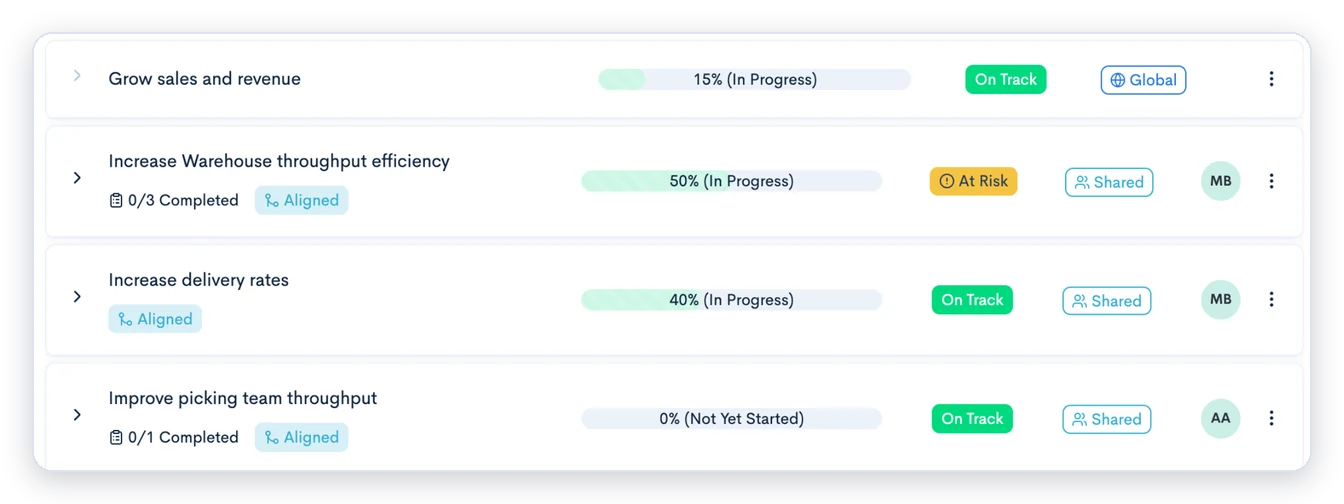
Good objectives say what should be different, and their key results say how you will know. Written as objectives and key results (OKRs), each objective is a short statement of the outcome, owned by one person and often linked to a team or organisation objective, with two or three measurable key results. Three to five objectives suits most people, with at least one for development. This guide gives a template, examples of objectives for line managers, office roles, frontline roles and HR, and how to review key results at one-to-ones while there is still time to help.
How do you write an objective and its key results?
Name what should be different and, where it fits, link it to something bigger, then add the key results that will show it has happened. Start from this template:
Objective: [what should be different], [where it fits: in support of a team or organisation objective].
- Key result: [a measure] from [baseline] to [target] by [date].
- Key result: [a second measure, often of quality, safety or service] from [baseline] to [target] by [date].
- Actions: [what the person will do to get there].
- Owner and review: [one named person], reviewed at each one-to-one and in full at the appraisal.
For example, for a shift manager:
Objective: people can plan their lives around the rota, in support of the site's objective of keeping more staff.
- Key result: the rota is published two weeks ahead, every week from next month.
- Key result: changes after publication fall from [baseline] to [target] a month within six months.
- Actions: set a weekly cut-off for holiday requests.
The first key result alone could be met by publishing early and changing the rota later. The second keeps the objective honest. Ten Space works this way too: you set objectives, and measure progress with key results.
What makes a good objective?
Check each objective, with its key results, against five questions:
- Is it specific? Someone else could read it and know what success looks like.
- Is it measurable? Its key results let you tell, without arguing, whether it was met.
- Is it owned? One named person is responsible for it, even when a whole team works on it.
- Is it timed? Each key result has a date, or a point in the year when you will check.
- Is it linked, where it fits? If it supports a team or organisation objective, it says which, so the person can see why it matters.
Make objectives stretching, and explain them. Summarising 35 years of research, Locke and Latham found that specific, challenging targets generally lead to better performance than asking people to do their best, when people are committed to the target, get feedback on progress and are able to reach it. A target a manager sets works as well as one agreed together, as long as the reason for it is explained (Locke and Latham, American Psychologist, 2002). Key results are that feedback, so agree how the person will see them move.
How do OKRs compare with SMART objectives?
They are close relatives: both ask for something specific, measurable and dated. A SMART objective (specific, measurable, achievable, relevant and time-bound) packs the outcome, the measure and the date into one sentence. An OKR separates them: the objective says in plain words what should be different, and two or three key results say how you will know, each tracked on its own.
Key results, the measurable part, do three jobs:
- They show progress. A key result part of the way to its target shows where an objective stands during the year, not only at the end.
- They keep an objective honest. An objective can sound achieved when little has changed. A second key result, for quality as well as speed, stops one being bought at the cost of the other, as in the rota example.
- They give a conversation something concrete. At a one-to-one, "the wait is down to 20 minutes, but complaints are up" is a better start than asking how things are going.
Keep key results to outcomes: what will be true, not what someone will do. "The mystery-shop score rises from 82% to 90%" is a key result; "brief the team every shift" is an action. List actions separately, because they can all be done without the result moving, and that is worth a conversation.
What are good examples of objectives and key results?
The examples below are illustrations to adapt, and the numbers are placeholders: set each target from your own baseline, so that it stretches without being out of reach. Where a result also depends on things the person doesn't control, such as staffing or demand, pair it with a key result for quality, safety or service, or make the key results about what they control.
Line managers
Objective: everyone in the team knows what they are working towards, and why.
- Key result: each person has three to five objectives, each supporting a team objective or their own development, within six weeks of the appraisal.
- Key result: no objective goes more than a month without its key results being reviewed.
Objective: people coming back from absence get the support they need.
- Key result: every absence is followed by a supportive return-to-work conversation within the time your absence policy sets.
- Actions: review absence trends every three months, and arrange support where it's needed.
Office and support roles
Service desk objective: problems are fixed quickly, and fixed for good.
- Key result: 90% of support requests are resolved within one working day, within six months.
- Key result: reopened requests fall from [baseline] to [target].
Finance objective: leaders get accurate figures in time to act on them.
- Key result: the month-end accounts close within five working days, every month from month six.
- Key result: no corrections are needed after sign-off.
Warehouse and logistics teams, and drivers
Team leader's objective: the shift can cover absence without falling behind.
- Key result: everyone on the shift is trained in at least two areas, such as picking and goods in, by the next appraisal.
- Key result: missed dispatch cut-offs caused by absence fall from [baseline] to [target].
Driver's objective: deliveries arrive safely, when promised.
- Key result: on-time deliveries on your routes rise from 92% to 96% by the next appraisal, leaving out delays you couldn't control, such as late loading.
- Key result: safety incidents stay at or below this year's level.
Retail and hospitality shift managers
Objective: shoppers get the service standard on every shift.
- Key result: the mystery-shop score on your shifts rises from 82% to 90% within six months.
- Key result: complaints about service fall from [baseline] to [target] in the same period.
- Actions: brief the team on the service standard at the start of every shift.
Objective: guests get their food quickly on the busiest evenings, without corners being cut.
- Key result: the average wait for food on Friday and Saturday evenings falls from 22 minutes to 18 within six months.
- Key result: every food safety check is completed, with no rise in complaints about the food.
Care workers and senior carers
Adapt these to your service: processes vary by provider, by role and by each person's care needs.
Care worker's objective: the care plans of the people you are key worker for keep up with their needs.
- Key result: every plan is reviewed on schedule, none more than seven days late, checked at supervision.
- Key result: every review includes the person, or someone who speaks for them.
Senior carer's objective: nothing important about a person is lost between shifts.
- Key result: every shift change has a handover covering each person you support, from within a month.
- Key result: no gaps are found in the monthly audit.
HR
Objective: survey results lead to action in every team.
- Key result: every team has its survey results within two weeks of the survey closing, and an agreed action plan within six weeks.
- Key result: agreed actions done by their due date rise from [baseline] to [target] by the next survey.
What kinds of objective are there?
There are three levels:
- Organisation-wide objectives set the direction for everyone, such as keeping more new starters, with the key result "leavers in their first three months fall from one in four to one in six by the year end".
- Shared objectives belong to a department or a team: a shift, a depot, a store or a care home.
- Personal objectives belong to one person. Many link to a shared or organisation-wide objective, but they don't have to: a development objective often stands on its own, and still matters.
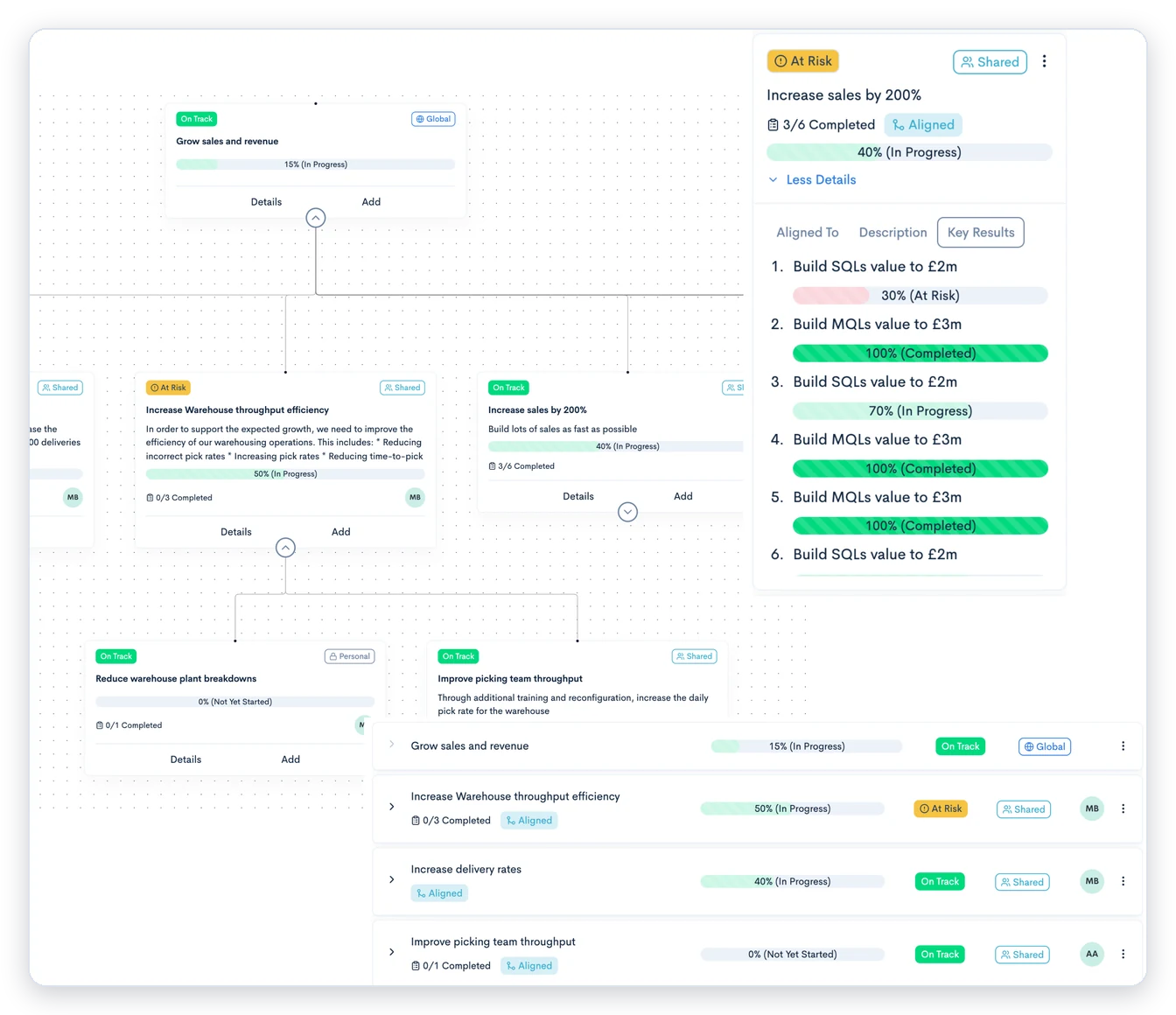
Objectives cascade: the board sets a handful, each department and team turns them into its own, and each person's objectives can show their part. A key result at one level often becomes an objective at the next.
Seeing objectives as a tree, each under the one it supports, helps each person see how their work connects to the objectives above it. Gaps stand out, such as an organisation objective with nothing beneath it, as do overlap and a team pulling a different way. In Ten Space, the objectives tree view shows this cascade and how everything links together.
What do development objectives look like?
A development objective is about what someone will learn, not only what they will deliver, and it needn't link to anything above it. Put at least one beside the others, so that growing is part of the job, not extra to it. For example:
Objective: be ready to run a closing shift alone.
- Key result: signed off by the shift manager as ready to close alone, within six months.
- Actions: shadow five closing shifts, then close two with the shift manager on call.
When someone is learning something new and complex, a hard number can backfire. Locke and Latham report that a performance target can make people so anxious to succeed that they don't learn what works, and recommend a specific learning objective instead, such as finding a set number of ways to do the task (Locke and Latham, American Psychologist, 2002). For a new shift manager, "three ways of planning the rota tried, and the best one kept" is a fairer first key result than "agency hours cut by 10%".
Development objectives often come out of 360 feedback or an appraisal, and belong in a plan the person follows.
See employee development plans that get done for more.
How can survey results become objectives?
Start from a team's survey results, agree a shared objective, and let each person's objectives show their part in it. Work from the team's results, never from one person's answers. Nobody's survey answers should reach their appraisal, their 360 or their manager.
For example, a retail store's engagement survey results, taken together, show that people don't feel listened to: they raise ideas and concerns, and don't hear back. That team-level finding becomes a shared objective, and the store manager takes one of their own:
The store's shared objective: people feel that the ideas and concerns they raise are heard and answered.
- Key result: the favourable response to the survey's question on feeling listened to rises from the store's current level to a target set from that baseline, by the next pulse survey.
The store manager's own objective: every idea and concern the team raises gets a clear answer.
- Key result: every idea or concern gets a reply within a week, saying what will happen and why, starting within two weeks of the results being shared.
- Key result: every change promised in a reply is made by the date given, or the team hears why not.
- Actions: keep a log of each idea or concern and its reply, and go through it at each one-to-one with their own manager.
The store manager may lead the shared objective, but their own objective rests on what they do, not on the team's next score. Involve the team in deciding what would help: they often know. Then tell people what changed.
See you said, we did for more.
In Ten Space, goals can be viewed and managed next to survey results, appraisals, 360s and one-to-ones, so an objective can sit beside the survey result it came from. The actions you agree after a survey can carry through to goals for each department, team and person (action planning). With the ethics filter enabled (the most common setup), results are only shown for groups of six or more.
How do you track progress on key results?
Update key results as the year goes on, and give each objective a status that is simple to understand at a glance:
- Green: on track.
- Amber: at risk, and worth talking about.
- Red: off track, and needs help now.
An analysis of 138 studies found that keeping track of progress helps people achieve what they set out to do, and helps most when progress is recorded or shared with others (Harkin and others, Psychological Bulletin, 2016). So write progress down, look at it together at regular one-to-ones, and make it visible to the people who can help.
In Ten Space, an overview shows who needs support, so a manager can help in the next one-to-one, not at the year end.
How do you keep objectives alive all year?
Objectives read only at appraisal time rarely shape the year. Give them three places to come up:
- One-to-ones. Make key results a standing item at every regular one-to-one, whether between a manager and a member of their team or a coach and the person they support: what has moved, what is stuck and what help is needed. A short monthly check does more than a long yearly one, while there is still time to help.
- A mid-year review. Check that each objective and its key results are still the right ones, and change them if the work has changed.
- The appraisal. Look back at the year's record, not at memory, and agree next year's objectives as the last step.
Make the commitment visible. An objective that is written down and seen by the people it involves, such as a manager and the team, is a commitment, not a private intention, and someone else expecting progress helps it happen. The analysis of 138 studies above points the same way: tracking progress helped most when the results were reported to others or made public.
Let reminders do the chasing. Between conversations, objectives slip out of view. In Ten Space, reminders and nudges go out automatically as objectives near their due date, so nobody has to chase and nothing waits for the appraisal.
Our guide on how to run a staff appraisal covers the whole process, and continuous performance management shows how surveys, 360s, appraisals and one-to-ones fit into one cycle.
How Ten Space helps
Ten Space is a UK-based employee survey and performance management platform.
- Objectives that cascade. Set organisation-wide, shared and personal objectives, and cascade them through departments and teams to each person.
- See how your team's objectives fit together. Managers can easily see the objectives of everyone in their team, how they link together and how they feed up to shared and organisation-wide objectives.
- Starting from your surveys, 360s and appraisals. Turn what a survey found into goals for each department and team, and what a 360 or an appraisal found into a person's own goals.
- Progress that's simple to understand. Every objective has a red, amber or green status and a history, so where it stands is clear at a glance. You can also measure progress with key results, and an overview shows who needs support. So a manager can help in the next one-to-one.
- Linked to reviews and one-to-ones. Goals link to 360s, appraisals and one-to-ones, so they come up where the conversations happen, and an appraisal draws on the person's full history, not on memory.
- Access you control. Everyone sees what their role allows, and only that. You set the restrictions.
We set the platform up for you, and expert help, training and support are always included. Every client has a dedicated client success manager: a named UK-based expert who works alongside your team.
See goals and objectives for more.
Frequently asked questions
What is the difference between an objective, a key result and an action?
An objective is what should be different, a key result measures whether it has happened, and an action is something a person does to get there. A key result is an outcome; an action can be done without the result moving.
How many objectives and key results should someone have?
Three to five objectives suits most people, with at least one for development, and two or three may be right for a tightly defined frontline role. Give each objective two or three key results, or one where a second would only repeat it. Beyond that, some are probably actions, or belong to the team.
Should objectives be set at the appraisal?
The appraisal is a good place to agree next year's objectives, after looking back at this one. But don't wait for it when someone starts or changes role, and review key results at one-to-ones in between. Set team objectives first, so that personal ones can link to them where they fit.
Can objectives change during the year?
Yes. If the work changes, the objectives and key results should too. Agree the change at a one-to-one or the mid-year review, note why, and keep the old objective on record, so the appraisal reflects what was asked at the time.
See how objectives are set, tracked and reviewed in Ten Space. Book a 30-minute demo.