Good 360 feedback questions ask about things people have seen the person do, one idea at a time, on the same rating scale for everyone, with a few open questions at the end. They ask about behaviour the person can change, not about their personality, so the answers give them something to work on. This guide gives a starter questionnaire built on the five areas of our 360 feedback model, and more example questions by area and by relationship. It also covers what the research says makes a 360 work, and how to turn the answers into a plan, not just a PDF.
How do you choose 360 feedback questions?
Choose questions about behaviour that the people answering have actually seen, and keep each one simple to answer.
- Ask about behaviour, not personality. "Explains the reasons for decisions" can be seen and changed. "Is a good communicator" can't.
- One idea per rated question. "Listens to feedback and acts on it" is two questions. Someone who listens but never acts can't answer it honestly.
- Use the same scale for every question. A frequency scale suits behaviour, from 1 (rarely) to 5 (almost always). Keeping the questions and the scale the same lets you compare themes, groups and a follow-up 360.
- Add a "not seen this" option. A peer on a different shift may never see how someone briefs their team. Without it, people guess.
- Build on a model. A model groups the questions into a few areas, so the results show where someone is strong and where they could grow, not just a list of scores. Our 360 feedback model looks at five areas of behaviour: direction and clarity, integrity and trust, adaptability and improvement, empowerment and growth, and collaboration and belonging. It is for developing leadership, not only in managers, and the questions in this guide are built on its five areas. In 360 Performance, you can use our model and questions, or your own model, values and questions. If you use your own values, keep your organisation's words, and turn each value into something people can see: if a value is "we're one team", ask what that looks like on a normal day.
- Write for the people answering. Leave out HR language. "Gives me the information I need to do my job well" works for a care worker, a warehouse picker and a finance assistant alike.
Some organisations call these 360 appraisal questions, because the answers feed into a staff appraisal or performance review. The rules for writing them are the same.
Is there a 360 feedback template I can use?
Yes. This starter questionnaire follows the rules above and is built on the five areas of our 360 feedback model: 20 rated questions for colleagues, a short version for clients and three open questions. Adapt it to the role, and use your own word for the people you serve: clients, service users, residents, patients, guests or shoppers. Replace any question that doesn't fit with one from the lists below. Keep the shared questions and the scale the same for every group and every follow-up 360, so the results can be compared. A 360 tool makes that easier: in 360 Performance, you build a template once, so everyone in a programme is asked the same things in the same way.
How to answer. Think about what you have seen [name] do. Rate how often they do each thing: 1 Rarely, 2 Sometimes, 3 Often, 4 Usually or 5 Almost always. If you haven't seen it, choose "Not seen this".
Part 1: for their manager, their peers and the people who report to them. [Name] answers these too, about themselves, in the first person.
Direction and clarity
- [Name] keeps me informed about things that affect my work.
- [Name] explains the reasons for decisions.
- [Name] sets clear priorities when there is more to do than time allows.
Integrity and trust
- [Name] does what they say they will do, when they said they would.
- [Name] treats everyone fairly, whatever their role.
- [Name] owns up to mistakes.
Adaptability and improvement
- [Name] is open to new ideas, including ones that aren't their own.
- [Name] listens without interrupting, even when they disagree.
- [Name] looks for what to learn when something goes wrong, rather than who to blame.
Empowerment and growth
- [Name] shares what they know, so others can do their job well.
- [Name] trusts others to get on with their work, without checking every step.
- [Name] encourages others to learn new skills.
Collaboration and belonging
- [Name] helps colleagues who are under pressure, without being asked.
- [Name] gives others credit for their work.
- [Name] helps new starters settle in.
Part 2: for the people [name] leads. One question for each area. Leave this part out if they don't lead a team, a shift or a project, and add more from the lists below if you need them.
- [Name] makes clear what they expect of me.
- [Name] responds calmly when I raise a concern.
- [Name] asks for my ideas on how we could do things better.
- [Name] makes time to talk about how I can develop.
- [Name] thanks people for good work.
Part 3: open questions, for everyone.
- What should [name] start doing, stop doing and continue doing?
- What is one thing [name] could do differently that would make the biggest difference to you?
- When have you seen [name] at their best?
When [name] answers about themselves, ask instead: What are you most proud of in your work this year? What would you most like feedback on?
For clients and other people outside the organisation, use these in place of parts 1 and 2, on the same scale, then the open questions:
- [Name] gets back to me promptly when I get in touch.
- [Name] does what they agree to, on time.
- [Name] is courteous when working on our site.
What are good example 360 feedback questions?
Good examples are short statements about one behaviour each, rated on the same scale, like those in the starter questionnaire. These 360 feedback examples are more to swap in, one for each area of the model, so you can fit the questionnaire to the role.
- Direction and clarity. [Name] gives a clear handover, so the next shift can pick up where they left off.
- Integrity and trust. [Name] follows safety rules, even under pressure.
- Adaptability and improvement. [Name] tries a new approach when the usual one isn't working.
- Empowerment and growth. [Name] gives others the chance to take on new responsibilities.
- Collaboration and belonging. [Name] makes everyone feel part of the team, whatever shift they work.
Which 360 feedback questions suit each relationship?
Ask every group of colleagues, and the person themselves, the same shared questions, then add a few relationship-specific ones. A comparison between groups, or with a follow-up 360, only means something when everyone answered the same question on the same scale. For example, a manager may rate someone highly on "[Name] explains the reasons for decisions", while the people who report to them rate the same question much lower. That gap is often the most useful thing in the report. Here are more questions to swap in, beyond those in the starter questionnaire, each with the area it fits.
Their manager
- [Name] raises problems early, before they grow (integrity and trust).
- [Name] acts on the feedback I give them (adaptability and improvement).
Their peers
- [Name] makes time to help when I ask (collaboration and belonging).
- [Name] shares the load fairly on a busy shift or a busy week (integrity and trust).
- [Name] gives me honest feedback in a way I can use (empowerment and growth).
The people who report to them
- [Name] helps me put things right when something goes wrong (adaptability and improvement).
- [Name] gives me regular, useful feedback on my work (empowerment and growth).
Clients and other people outside the organisation
Ask clients only about what they see. Give them a short set of their own, in place of the shared questions, in plain words with no internal language, as the starter questionnaire does. A client may see more of a delivery driver's work than colleagues at the depot do.
Self-assessment
Ask the person to rate themselves on the same shared questions, in the first person: "I explain the reasons for decisions." Comparing their view with everyone else's shows where they see themselves as others do, and where they don't. Give them two open questions of their own, as in the starter questionnaire.
Expect a gap. Across many studies, people's ratings of themselves agree only moderately with their manager's and peers' ratings, while managers and peers agree more closely with each other (Harris and Schaubroeck, Personnel Psychology, 1988). Both views count: in one study, looking at self-ratings and others' ratings together, including which was higher, helped explain how effective people were (Atwater and others, Personnel Psychology, 1998). So treat the gap as a question to explore, not a verdict.
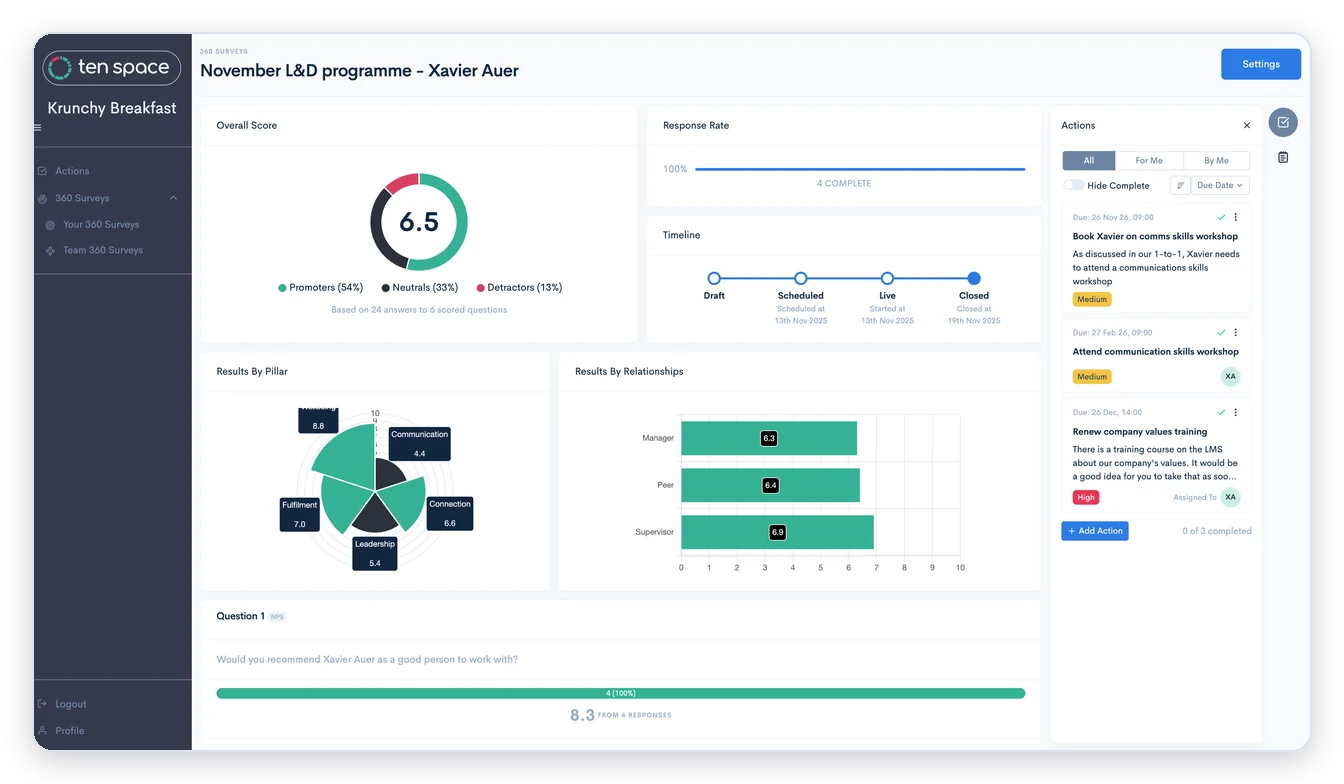
A 360 tool can show you where the gaps are. In 360 Performance, Ten Space's 360 feedback tool, when the person gives their own feedback too, their results compare their view with how others see them, for each area of the model, and show how each group sees them, such as their manager, peers or clients. Start the conversation from the biggest gaps, then agree actions from the feedback, each with an owner and a due date, and track them. The gap becomes the starting point for effective conversations and improvement.
What are good 360 feedback questions for leaders?
Good 360 questions for leaders cover the same five areas, at the level of the whole team or organisation: where it is going, the standards they set and the culture they create.
- [Name] explains how our work fits with where the organisation is going (direction and clarity).
- [Name] holds themselves to the same standards they set for others (integrity and trust).
- [Name] encourages the team to try better ways of working (adaptability and improvement).
- [Name] coaches the managers in their team (empowerment and growth).
- [Name] keeps people who work nights, weekends or away from the main site as well informed as everyone else (collaboration and belonging).
These work for frontline leaders too. For a retail or hospitality shift manager, a warehouse team leader or a care home manager, ask about what they do on shift, in front of their team.
Which open questions get useful answers?
Two or three open questions at the end are enough, such as "What should [name] start doing, stop doing and continue doing?" The three in the starter questionnaire work for most 360s. The ratings show where someone is strong or could improve; the comments show why, and what to do about it.
Ask for examples, not labels. "Gave me a clear handover every morning" helps someone grow. "Great" doesn't.
What does the research say about 360 feedback?
On average, ratings improve only a little after a 360, and more for some people than others. A review of 24 studies that followed people over time found that improvement is generally small, and set out when it is most likely (Smither and others, Personnel Psychology, 2005):
- The feedback shows that change is needed, and the person sees that need.
- They react positively to it, and believe change is feasible.
- They set goals and take action.
That is one reason to ask about behaviour: it points to something the person can change. The rest depends on how you set the 360 up and what happens afterwards, which the next two sections cover.
Before you send it: who should you ask, and how should you brief them?
Ask people who work with the person often enough to have seen what the questions ask about, and tell them what the feedback is for before they start.
- Choose people who see the work. Often that is a mix of the person's manager, peers and the people who report to them, and sometimes clients. Choose for what each has seen, not for seniority or friendship.
- Involve the person. Let them help choose who gives feedback, and ask those colleagues for it themselves. It helps them own the result.
- Say what it is for, whether that is development, an appraisal or a leadership programme.
- Say who will see the results, and when. Be straight about confidentiality, including its limits: in a small group, or from a detailed comment, people may be able to tell who said what.
- Ask for comments that are specific and kind. "Say what you saw, and the effect it had."
- Make it easy to answer. If participants work shifts, drive for a living or sit outside the organisation, a link to a desktop form won't reach them all. 360s in Ten Space can be completed by email, SMS or WhatsApp, so people without a desk or a work email can take part, and so can clients.
Saying what it is for matters, because purpose can change the answers. In appraisals generally, ratings given for pay or promotion were more lenient, on average, than those given for development or research (Jawahar and Williams, Personnel Psychology, 1997). If a 360 may inform an appraisal, say so before anyone answers, and read the ratings with that in mind. If it is part of a performance improvement plan (PIP), describing it as development is enough: the plan itself is sensitive, and usually best kept between the person, their manager and HR.
See our PIP and 360 checklist and using 360 feedback assessments to strengthen your performance improvement plans for more.
After the answers: how do you turn 360 feedback into growth?
Share the results in a conversation, pick two or three themes and agree actions, each with an owner and a due date. A report on its own changes little. Too often, the person reads it and puts it away: "Sometimes, it's never discussed again" (Zenger and Folkman, Harvard Business Review, 23 December 2020).
- Talk it through, don't email it. Share the results with someone who can help the person make sense of them: their manager, someone in HR or a coach. In one study of more than 1,300 senior managers, those who worked through their feedback with a coach were more likely to set specific goals and ask their own managers for ideas, and improved a little more a year later (Smither and others, Personnel Psychology, 2003). In 360 Performance, results can be held back until that conversation has happened.
- Start with strengths. Say what people value, and how the person can use it more. Then turn to the lower ratings with care. In one study, people given lower ratings tended to doubt them and react badly, and those who reacted badly found the feedback less useful (Brett and Atwater, Journal of Applied Psychology, 2001).
- Look for patterns, not single comments. One sharp comment is one view. The same point from several people, a gap between groups on the same question, or a gap between the person's own rating and everyone else's, is a theme. One rating is one view too: in a study of more than 4,000 managers, differences between the individual people rating them explained more of their ratings than the managers' own performance did (Scullen and others, Journal of Applied Psychology, 2000).
- Pick two or three themes. More than that is hard to act on.
- Agree actions, each with an owner and a due date. "Ask the team for one thing to improve at the end of each month" is an action. "Communicate better" isn't.
- Close the loop with the people who gave feedback. Where appropriate, the person thanks them, shares the themes they will work on and asks for ideas. Talk about themes, never about who said what. In one five-year study, managers who met the people who report to them to talk about their feedback improved more than those who didn't, and more in the years when they did (Walker and Smither, Personnel Psychology, 1999).
- Link the actions to the person's objectives, and talk about them in regular one-to-ones, so they don't wait a year.
- Run a follow-up 360 and compare it with the first. Ask the same questions, on the same scale, of a similar group, to see what has changed. As a rule of thumb, six to twelve months gives the person time to act and others time to notice. Repeated rounds can show lasting change: in one study of managers given feedback by their teams four times over two and a half years, those who started with low ratings improved by the second round and kept the improvement (Reilly and others, Personnel Psychology, 1996).
For example, a warehouse team leader's 360 shows that everyone rates them highly on integrity and trust. But the people on their shift rate them much lower than their manager and peers do on "explains the reasons for decisions", and low on helping new starters settle in. They agree two actions: explain any change to the pick plan at the start of the shift, with the reason, and check in with each new starter at the end of their first week. At the next briefing, they thank the shift for their feedback, say which two things they will work on and ask for ideas. Their manager asks about both actions at their monthly one-to-one. Nine months later, a follow-up 360 asks the same questions, on the same scale.
How 360 Performance helps
Ten Space is a UK-based employee survey and performance management platform. 360 Performance is its 360 tool.
- Your questions or ours. Use our model and questions, or your own model, values and questions.
- The right people. Set the requirements for who needs to take part: which relationships, such as a manager, peers or clients, and how many from each.
- One person or a programme. Run a 360 for one person when it is needed, or build a template once, so everyone in a programme is asked the same things in the same way.
- Released when you're ready. Results are confidential, and released when you're ready, by whoever you choose: a manager, someone in HR, a coach or a consultant.
- From feedback to a plan. Explore the results, and make and share notes on them. Read an AI summary, with prioritised, suggested actions you can accept, assign or ignore. The decisions stay with you. Agree actions from the feedback, each with an owner and a due date, and track them. Link goals, notes and actions to the feedback, and compare a follow-up 360 with the first.
- A report that suits the person. Each person can have a login to see their report, actions and goals in Ten Space, or simply receive a PDF report.
We set the platform up for you, and expert help, training and support are always included. Every client has a dedicated client success manager: a named UK-based expert who works alongside your team.
See 360 Performance and building better conversations: introducing 360 Performance for more.
Frequently asked questions
How many questions should a 360 have?
Enough to cover the themes that matter, and few enough to answer in one sitting. For most 360s that means around 20 to 30 rated questions and two or three open ones. Give clients and other people outside the organisation fewer, about what they see.
Who should give 360 feedback?
People who work with the person often enough to have seen what the questions ask about: often their manager, their peers and the people who report to them, and sometimes clients or other people outside the organisation.
Can clients give 360 feedback?
Yes. Clients often see things colleagues don't, such as how someone keeps them informed or handles a problem. In 360 Performance, clients and other people from outside the organisation can take part.
Is 360 feedback anonymous?
Although the names of participants aren't shown alongside their responses, the small number taking part (typically five to ten) and their close relationship with the person mean that anonymity can't be guaranteed. Results are confidential, and released when you're ready, by whoever you choose: a manager, someone in HR, a coach or a consultant. Who sees what is set by permissions you control.
How often should you run a 360?
Run one when the results will be used: for regular development, in a leadership or coaching programme, or as part of a performance improvement plan. An annual cycle can be a useful starting point for regular development, provided there is time to act on the feedback between reviews. After a 360 that leads to actions, a follow-up six to twelve months later, with the same questions and scale, shows what has changed.
See how 360 Performance turns feedback into a plan. Book a 30-minute demo. Or use our free PIP and 360 checklist.