An employee development plan is a short plan, agreed by a person and their manager, of what the person will work on, how and by when. At its heart are one or two objectives and a few actions under each, every action with an owner, a due date and a check-in. One-to-ones keep the plan moving. Appraisals and 360 feedback feed it at the start, and help show whether it worked at the end. Feedback creates value when it is turned into agreed objectives, actions and follow-up: that is how a 360 or an appraisal leads to growth.
What is an employee development plan?
A good plan is short: a page, or one screen on a phone. It is agreed, not handed down. And it is live: talked about through the year, not filed after the appraisal. It is not a list of courses, and it is not a performance improvement plan (PIP).
Where does a development plan start?
It starts with evidence about how the person is doing, and with what they want next.
-
A 360. 360 feedback shows how someone's work lands with the people around them, such as their manager, their peers and the people they lead. Pick two or three themes, not every comment. A model helps: our 360 feedback model groups the feedback into five areas, such as direction and clarity, and empowerment and growth.
See 360 feedback questions for more.
-
The appraisal. A difference between a person's self-review and their manager's review can be a useful starting point for a conversation about expectations, evidence and development.
See how to run a staff appraisal for more.
-
One-to-ones. The same difficulty may keep coming up, or the person may mention a project they would love to lead.
- What the person wants next. A role they are aiming for, or a skill they want. A plan built only from criticism is hard to care about.
A team's employee survey results can give context, such as a team saying it hears about changes too late. But survey results describe a group, never one person, and nobody's survey answers belong in their development plan.
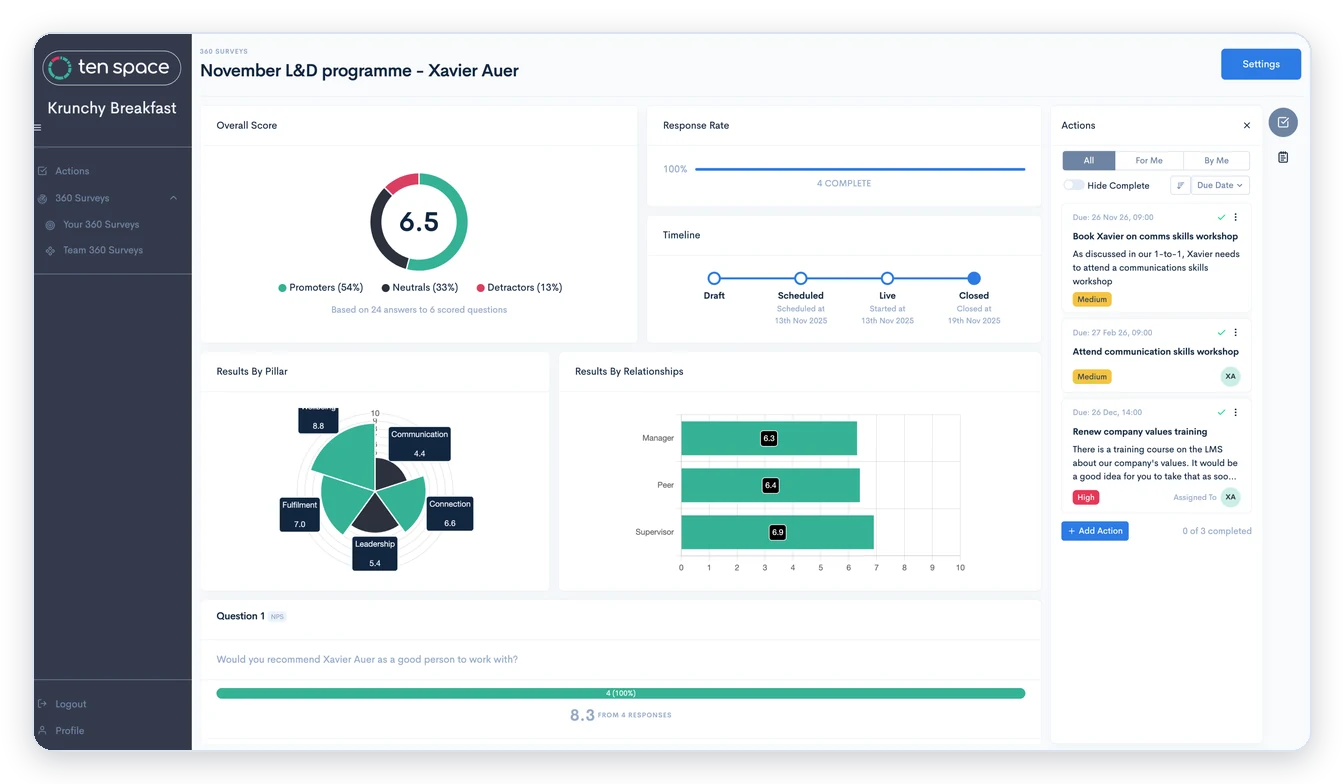
In Ten Space, each 360 and each appraisal comes with an AI summary and prioritised, suggested actions you can accept, assign or ignore: a starting point for the conversation. The decisions stay with you.
What goes in an employee development plan?
Objectives and actions come first. Everything else in the plan is there to make them happen.
-
One or two objectives. What the person is working towards, in a sentence that says what will be different. Two is plenty alongside a day job. A development objective can sit beside someone's other objectives, so that growing is part of the job, not extra to it.
See examples of objectives and key results for common roles for more.
-
Two or three actions under each objective, each with one owner and a due date. "Get better at delegating" is an objective. "Hand the weekly rota to a team member, with a ten-minute check every Friday" is an action. For something regular, such as a weekly briefing, set a start date and a point to review it.
- The support each action needs: a course, a mentor, shadowing a colleague, a stretch task or time away from the floor. Consider every suitable way to meet a learning need, "rather than defaulting to 'a course'" (CIPD, Learning needs analysis, 20 August 2025).
- How you will know the action has worked: something you can check, such as a task finished, a change others can see or a check-in with agreed questions. For complex skills, objectives about learning and improving often suit better than rigid targets (CIPD, Performance management: an introduction, 29 January 2026).
- A status for each action: red if it is off track, amber if it is at risk, green if it is on track, and done when it is finished.
- Where it is talked about and reviewed: usually the regular one-to-one, then the next appraisal or a follow-up 360.
Is there an employee development plan template I can use?
Yes. Fill in the table once, then add one block for each action: two or three under each objective. A sheet of paper or a document can work, but it is easy to forget about and easy to lose. Keep the plan in a tool, where it will come up at every one-to-one, not in a file that is opened once a year. In Ten Space, goals can be viewed and managed next to survey results, appraisals, 360s and one-to-ones. Actions can be viewed next to the objectives they serve, and both can be viewed on their own at any time, so progress is easy to follow.
About the plan Name and role Agreed with (a manager, coach or mentor) Date agreed Where it started (a 360, an appraisal, one-to-ones, the person's own aim) Talked about at (for example, each monthly one-to-one) Next full review Objective 1: (what will be different)
Action 1a
- Action:
- Owner: (one person)
- Due date: (for something regular, a start date and a review point)
- Support:
- How we'll know:
- Status: (red, amber, green or done)
Add more action blocks the same way, and a second objective if you need one.
What do good employee development plans look like?
Good plans are short and specific, with an owner and a date for every action. These four examples are illustrative. Swap in your own people's objectives and dates. The first is the template filled in; the other three are shorter.
A new manager after a first 360: the template filled in
For example, a newly promoted office team leader's first 360 rates them well on collaboration and belonging: people find them approachable. It rates them lower on direction and clarity, because decisions reach the team late, and on empowerment and growth, because they still do much of the work themselves. This is their plan at the end of month one.
About the plan Name and role (their name), newly promoted team leader Agreed with Their manager Date agreed Week 1, at the one-to-one about the 360 Where it started Their first 360 Talked about at Each one-to-one, every two weeks Next full review The end of month six Objective 1: share decisions sooner, and hand more of the work to the team.
Action 1a
- Action: a ten-minute team briefing every Monday.
- Owner: the team leader.
- Due date: from week 1, reviewed at the end of month two.
- Support: their manager shares decisions coming up by each Friday.
- How we'll know: at the review, the team leader asks the team whether they now hear about changes at the briefing first.
- Status: green.
Action 1b
- Action: hand the weekly rota to a team member, checking it together each Friday.
- Owner: the team leader.
- Due date: handed over by the end of month one, with Friday checks until a review at the end of month two.
- Support: half an hour to show the team member how.
- How we'll know: by the review, the team member writes the rota without help.
- Status: amber. The handover slipped a week while the team member was on leave.
Action 1c
- Action: shadow an experienced manager at two planning meetings.
- Owner: their manager, who arranges it.
- Due date: both by the end of month two.
- Support: an experienced manager from another team.
- How we'll know: the team leader brings one idea from each meeting to their next one-to-one.
- Status: green. One meeting is done, and the other is booked.
How we'll know the objective is met, at the month-six review: the actions are done; their manager has seen decisions reach the team at the briefing, not on the grapevine; the team leader gives their own view; and a follow-up 360 gives one more view of whether the team sees a difference.
A care worker stepping up to a senior role
For example, a care worker says at their appraisal that they would like to become a senior care worker.
- Objective: be ready to lead a shift within six months.
- Actions: complete the medication training the senior role needs by the end of month two (owner: the care worker; support: the course, and paid time for it). Shadow a senior care worker on three shift handovers, then lead three with them present, by the end of month four (owner: the care worker; support: the senior as mentor). Lead one care plan review alongside the registered manager by the end of month five (owner: the registered manager, who sets it up).
- How you'll know: the training is signed off, the senior care worker has seen them lead handovers without help and the care worker says they feel ready. The next appraisal brings that evidence together.
For people without a desk, keep the plan short enough to read on a phone, and hold the check-in at the start of a shift or at handover, within working hours.
A warehouse team leader
For example, a warehouse team leader rates their own coaching highly in their self-review. Their manager rates it lower, and one-to-ones show that new starters on the team often struggle in their first weeks.
- Objective: help every new starter be ready to work their shift on their own by the end of their fourth week.
- Actions: write a first-week checklist with the site trainer by the end of month one (owner: the team leader). Pair each new starter with a buddy on the same shift, from now on, reviewed at the end of month three (owner: the team leader). Attend a coaching skills workshop by the end of month three (owner: the operations manager, who books it).
- How you'll know: a week-four check-in with each new starter, using the same agreed questions. At the next appraisal, weigh their answers with what the operations manager has seen of the team leader's coaching and the team leader's own view, not just whether the two coaching ratings are closer.
Someone on a performance improvement plan
A development plan is about growth: the person helps shape it, and it runs for as long as it is useful. A PIP is a formal plan for when performance has fallen short of what the role needs, with the standard expected, the support on offer and a fixed period. It usually follows your organisation's own policy, so check that policy, and take advice where you need it.
For example, an accounts assistant is on a PIP because month-end reports are often late. The PIP sets the standard and weekly check-ins. A development plan doesn't replace that formal process. Our PIP and 360 checklist walks through running a fair PIP, and suggests considering a development plan to follow it.
How do you make a development plan stick?
Talk about it often, in the conversations you already have. A plan opened only at the appraisal rarely gets done.
- Make it a talking point on the one-to-one agenda. Any regular one-to-one, between a manager and a member of their team or a coach and the person they support, can spend five minutes on it: what has moved, what is stuck and what help is needed.
- Use reminders. A nudge a week before an action is due is kinder than a surprise at the review.
- Mark progress as it happens, not just before the appraisal. The CIPD's performance management factsheet also notes that keeping track of progress towards objectives is a strong motivator, and that regular conversations about performance matter more than formal process.
- Change the plan when the job changes. A new role or a shift in priorities is a reason to rewrite an objective, not to drop the plan.
In Ten Space, one-to-ones have a shared agenda of talking points, with notes and actions kept against each point and the goals you are discussing linked.
How do you know a development plan worked?
Look at several kinds of evidence together, and compare them with where the person started. No single score proves it.
- The agreed actions: which are done, and why any are still red or amber.
- Changes people have seen: what the person's manager, and the people they work with, have noticed them doing differently.
- The person's own view: do they feel more able, and do they know what they want next?
- Feedback from colleagues, where it is appropriate: a follow-up 360, compared with the first, is one indicator of whether the people around them see a difference.
Treat any one score with care. A 360 result, or the gap between a self-review and a manager's review, can move because different people answered, circumstances changed or perceptions shifted, not only because the person changed.
Then the next plan starts from what you find. Our guide to continuous performance management shows how that cycle joins up with your surveys, 360s and appraisals.
Is a person's plan the same as a team's action plan?
They work in the same way, but start from different places. A team plans actions after an employee survey: a few themes, each with an action, an owner and a date (see action planning). A person plans actions after a 360 or an appraisal, and talks them through at one-to-ones.
How Ten Space helps
Ten Space is a UK-based employee survey and performance management platform.
- Turning a 360 into actions. With 360 Performance, Ten Space's 360 feedback tool, you can agree actions from the feedback, each with an owner and a due date, track them, and compare a follow-up 360 with the first. Results are confidential, and released when you're ready, by whoever you choose: a manager, someone in HR, a coach or a consultant.
-
Starting the conversation from an appraisal. An appraisal can be a self-review only, or a self-review plus a manager review, with the gaps between the two highlighted. AI support suggests prioritised actions from each review, which you can accept, assign or ignore, and talking points for the one-to-ones that follow. The decisions stay with you.
See appraisals for more.
-
Following up actions between reviews. One-to-ones are for any two people in a regular conversation, and the history of every conversation, with its notes and actions, lets you look back at what was agreed last time.
- Seeing how each objective is going. Set personal objectives, track their red, amber or green status, and measure progress with key results. Goals can be viewed and managed next to survey results, appraisals, 360s and one-to-ones.
- A team's plan after a survey. Action planning gives every action an owner and a due date. Reminders go out automatically, and progress is tracked for you.
- For people without a desk or a work email. Appraisals and 360s can both be completed by email, SMS or WhatsApp.
We set the platform up for you, and expert help, training and support are always included. Every client has a dedicated client success manager: a named UK-based expert who works alongside your team.
See goals and objectives for more.
Frequently asked questions
How often should a development plan be reviewed?
Talk about it briefly at every regular one-to-one, and update each action's status: red, amber, green or done. Review it properly every three to six months, asking whether the objectives are still the right ones, and look at it again at the appraisal. Change it whenever the job, or the person's aims, change.
Who owns an employee development plan?
Both people do. The person owns the actions they have agreed to take, and their manager owns the support: time, training, a mentor and the check-ins. Every action should name one owner, so that nothing falls between the two.
What is the difference between a development plan and a PIP?
A development plan is about growth, and the person helps shape it. A performance improvement plan (PIP) is a formal plan for when performance falls short, with a set standard, support and a fixed period. Keep the two distinct, so the person always knows which one they are on. Once a PIP has concluded successfully, a development plan can support longer-term growth, where that is appropriate and in line with your policy, but it never replaces the formal process.
Should a development plan be linked to the appraisal?
Yes. The appraisal is one of the best places to start a plan and to look back at it, and the plan's objectives can sit beside the person's other objectives. If there isn't time in the appraisal meeting, agree the plan at a one-to-one soon after, while the feedback is fresh.
See how objectives, actions, one-to-ones, appraisals and 360s fit together in Ten Space. Book a 30-minute demo.