From 30 October 2026, employers must take all reasonable steps to prevent sexual harassment of their employees, and must not let customers, clients and other third parties harass them. A few well-chosen questions in a regular pulse survey help you show that you are doing so. They hear about harassment that never becomes a complaint, show where the risk is, and track whether your steps are working. Below is what changes, what the regulator expects, the questions to ask and how to ask them safely.
Jump to: what changes · all reasonable steps · questions to ask · asking safely · using the answers
What changes on 30 October 2026?
Three parts of the Employment Rights Act 2025 come into force on 30 October 2026, under the Act's sixth set of commencement regulations (SI 2026/1065). They build on the duty to prevent sexual harassment that employers have had since 26 October 2024.
- "Reasonable steps" becomes "all reasonable steps". Since October 2024, employers have had to take reasonable steps to prevent sexual harassment of their employees in the course of their work. From 30 October, the law adds one word: all (section 20). Some sensible steps are no longer enough if there was another reasonable step you could have taken.
- Harassment by third parties. An employer must not permit a third party to harass its employees. A third party is anyone who isn't the employer or one of its employees: a customer, client, patient, guest, contractor or member of the public. The employer is in breach if the harassment happens while someone is at work and it failed to take all reasonable steps to prevent it (section 21). This covers every kind of harassment under the Equality Act, including harassment related to race, disability, religion or sexual orientation, not only sexual harassment. Until now, an employee couldn't bring a tribunal claim for third-party harassment alone. From 30 October, they can.
- The steps can be set out in regulations. The government can now specify steps that count as reasonable, such as carrying out assessments, publishing plans or policies, and steps on reporting harassment and handling complaints (section 22). None have been made yet. The government will consult first, and expects the regulations in 2027/28 (government factsheet). The duty applies from 30 October regardless.
What happens if an employer falls short hasn't changed, but more is now at stake. The Equality and Human Rights Commission (EHRC) can take enforcement action. And when a tribunal upholds a claim of sexual harassment, it must consider whether the employer met the duty; if it didn't, the tribunal can increase compensation by up to 25% (Equality Act 2010, section 124A). Since 6 April 2026, reporting sexual harassment has been protected as whistleblowing (section 23). And since 1 October 2026, people have had six months, not three, to bring a claim to an employment tribunal.
What does "all reasonable steps" mean in practice?
Acting before anything happens, and being able to show that what you do works. The EHRC calls the duty "anticipatory": employers shouldn't wait for a complaint before they act. Until regulations say more, the EHRC's guidance is the benchmark. It is updating that guidance for the 2026 changes, and its 8-step guide for employers sets out what it expects:
- Have an effective anti-harassment policy, and make sure everyone knows it.
- Engage your staff, through one-to-ones, staff surveys and exit interviews, to understand where the issues are and whether your steps are working.
- Assess the risk, and reduce it. The EHRC says an employer is unlikely to meet the duty without a risk assessment. The risk factors it lists include customer-facing work, lone and night working, working alone with a third party, alcohol, power imbalances and insecure contracts.
- Make it easy to report, including anonymously.
- Train managers and staff, and keep the training up to date.
- Handle complaints promptly and fairly.
- Deal with harassment by third parties. Tell customers, clients and contractors what you expect, and act when they cross the line.
- Monitor and evaluate what you do, including by surveying staff anonymously and comparing what they tell you with the complaints you receive.
Adding "all" raises the bar. The same words already appear in the defence an employer can use when one of its employees harasses someone, and employment lawyers expect the new duty to be read the same way. An employer will need to show there was nothing more it could reasonably have done. In that defence, the Employment Appeal Tribunal has said it matters how effective an employer's steps were likely to be, and have proved to be. In Allay (UK) Ltd v Gehlen (2021), the employer's equality and harassment training had been given about two years before the harassment. The tribunal called it "stale", and the employer's defence failed.
So it isn't enough to have taken steps: you need to know whether they work. The EHRC lists whether steps have been effective among the things that decide whether they were reasonable, and its guidance is plain: "Compliance with the preventative duty is not static."
Why ask about harassment in a pulse survey?
Because complaints show only a fraction of what happens, and a once-a-year survey shows it late.
- Most harassment is never reported. In the Government Equalities Office's 2020 survey, 29% of people in work had been sexually harassed at work, or somewhere work-related, in the previous year. Only 15% of them reported it formally. The most common reasons for keeping quiet were that it didn't seem serious enough, and fear for their career or of making work uncomfortable (Government Equalities Office, 2020 Sexual Harassment Survey, 2021). The EHRC warns employers not to assume that their number of complaints shows the real level of harassment, and to compare it with what other sources, such as staff surveys, tell them.
- The regulator and Acas both suggest surveys. The EHRC's technical guidance says an employer can check whether its policies are working through staff surveys that ask everyone questions on an anonymised basis, and its 8-step guide names staff surveys in two of its eight steps. To check whether your policies and training are working, says Acas, "you could do a survey". In one of the EHRC's worked examples, a construction firm learns from an anonymous staff survey that women don't feel confident raising concerns, and commits to repeating the survey every six months to see whether what it is doing works.
- Waiting for complaints has already failed in practice. A tribunal found that Lidl GB had done no risk assessments and had relied on employees to complain before it acted. Under its later agreement with the EHRC, Lidl ran a staff survey on sexual harassment and assessed whether it needed to take further steps.
- A pulse keeps the picture current. A pulse survey is a short employee survey, normally fewer than ten questions, that you run regularly. A few harassment questions in each one show change as it happens, not a year later. Ask the same questions every time and you have a trend you can trust.
- It shows you where. Split by site, team, shift or role, the answers show where the risk is greatest, which is what your risk assessment needs.
- It reaches the people most exposed to third parties. The people who deal with customers, patients and the public are often on shifts or on the road, and may never open a work email. Ask them in a way that reaches them.
Ask regularly, and the same questions build a dated record: what you asked, what people told you, what you did about it and whether things changed. That record helps you show that your steps are reasonable, and that you check they work.
What harassment questions should you ask in a pulse survey?
A few core statements in every pulse, and a fuller set from time to time. The core statements sit in the wellbeing pillar of our engagement model: feeling safe, secure and supported. Use the same five-point scale as the rest of your pulse survey, so you can compare.
In every pulse: core statements (wellbeing). How much do you agree with each statement? 1 Strongly disagree, 2 Disagree, 3 Neither agree nor disagree, 4 Agree or 5 Strongly agree.
- I feel safe at work.
- I am treated with respect by the people I work with.
- I am treated with respect by the customers, clients or members of the public I deal with.
- I know how to report harassment at work.
- If I reported harassment, I am confident it would be taken seriously.
Choose two or three that fit your organisation, and keep them the same every time. In statement 3, use the word your people use: patients, residents, guests, passengers or tenants. Statements 4 and 5 test two of your steps directly: whether people know your reporting route, and whether they trust it.
The fuller set follows the structure the EHRC recommends. Ask it at a rhythm that suits you; in the EHRC's example, it is every six months.
From time to time: experiences of harassment. Choose the period to match how often you ask, such as "the last three months".
- In the last three months, has anyone at work done any of these to you? Choose any.
- Made sexual comments or jokes that made you uncomfortable
- Made comments about your body, appearance or private life that you didn't want
- Stared at you, or made gestures, in a sexual way
- Touched, hugged or kissed you, or stood too close, when you didn't want it
- Sent you sexual messages, pictures or videos, including on social media
- Kept asking you for a date, or asked you for sex, when you didn't want it
- Made offensive comments or treated you badly because of your sex, race, religion or belief, disability, age, sexual orientation or gender reassignment
- None of these
- Prefer not to say
- In the same period, have you seen any of these happen to someone else at work? Same list.
- Who did it? Choose any: a colleague; a manager or someone more senior; a customer, client, patient or member of the public; a contractor or someone from another organisation; prefer not to say.
- Did you report it? Yes, no or prefer not to say.
- If you didn't, why not? Choose any: I didn't know how; it didn't seem serious enough; I didn't think it would be taken seriously; I was worried about what would happen to me; I dealt with it myself; something else.
- If you did, how satisfied are you with how it was handled? 1 Very dissatisfied to 5 Very satisfied.
- If something like this happened in future, would you feel able to speak up? Yes, not sure or no.
- What more could we do to prevent harassment at work?
Why these questions work:
- They describe behaviour. The EHRC advises describing what happened rather than asking "Have you been harassed?". Many people don't call what happened to them harassment, and in the government's survey "it didn't seem serious enough" was the most common reason for not reporting it.
- They ask who. Question 8 separates harassment by colleagues from harassment by customers, clients and the public, which the new third-party duty now covers.
- They ask about reporting. Questions 9 and 10 measure the gap between what happens and what reaches you, which is the comparison the EHRC suggests. Question 10 tells you which of your steps to fix.
- They stay the same. Keep the period, the list and the wording the same each time, so a change in the answers is a real change.
If you already have your own values or framework, link the questions to it, and use your own words. What matters is that the questions describe behaviour, ask who and whether it was reported, and stay the same over time.
How do you ask about harassment safely?
- Keep it confidential, and report it for groups. The EHRC recommends asking on an anonymised basis. Show answers only for groups large enough that no one can be identified, and never show a manager how the few people in a small team answered.
- Say what the survey is, and what it isn't. A survey isn't a way to report harassment. Say so just before the harassment questions, and say how to report it and where to get support: the person or route to use, and any anonymous reporting line.
- Tell people before it opens why you are asking, who will see the answers and what you will do with them. Ten Space's Employee Promise is written to share with your people before a survey.
- Let people pass. Offer "prefer not to say" on every question about experiences of harassment, and don't make any of them compulsory.
- Act on what you hear, and say so. People stop answering questions that never lead anywhere.
How do you turn the answers into evidence?
- Compare the survey with your complaints. If 12 people say in a survey that a customer harassed them, and two complaints reached HR, the gap tells you that your reporting route isn't trusted or isn't known. Watch whether the gap closes.
- Find where the risk is. Look by site, team, shift and role, and by who did it: a colleague, a manager or a third party. Update your risk assessment with what you find.
- Agree a few actions, each with an owner and a date. "Brief every night-shift supervisor on handling a complaint by the end of November" is an action. "Tackle harassment" isn't. The EHRC suggests an action plan that says how each step will be monitored.
- Watch the trend. Ask the same questions next time, and see whether the actions made a difference. That is the test the EHRC's worked example sets itself.
-
Tell people what changed. Say what you heard, in general terms, and what you are doing about it.
See you said, we did for more.
-
Keep the record. What you asked and when, what you found, what you did and what changed. If your steps are ever questioned, a dated record shows what they were, and that you checked they worked.
Is a pulse survey enough to meet the duty?
No. A survey on its own doesn't prevent harassment. It tells you whether your steps are working and where to act next. You still need the other steps: a risk assessment, a clear policy, training, ways to report, good handling of complaints, and action on third parties. What is reasonable depends on your organisation: the EHRC lists factors such as its size and resources, its sector, the risks in its workplaces and its contact with third parties.
This article is general information, not legal advice. Take advice on your own organisation's position.
How Ten Space helps
Ten Space is a UK-based employee survey and performance management platform. Its pulse surveys are short, regular check-ins, normally fewer than ten questions, that show how your people feel between bigger surveys.
- Questions to start from. Start from our engagement model and ready-made questions, or use your own values and write your own questions. We work with you to fine-tune your questions.
-
The same questions, on your schedule. A pulse survey can repeat automatically on a schedule you set, so it is easy to track how answers change over time. Reminders go out automatically, and people who have already answered aren't chased.
See pulse surveys for more.
-
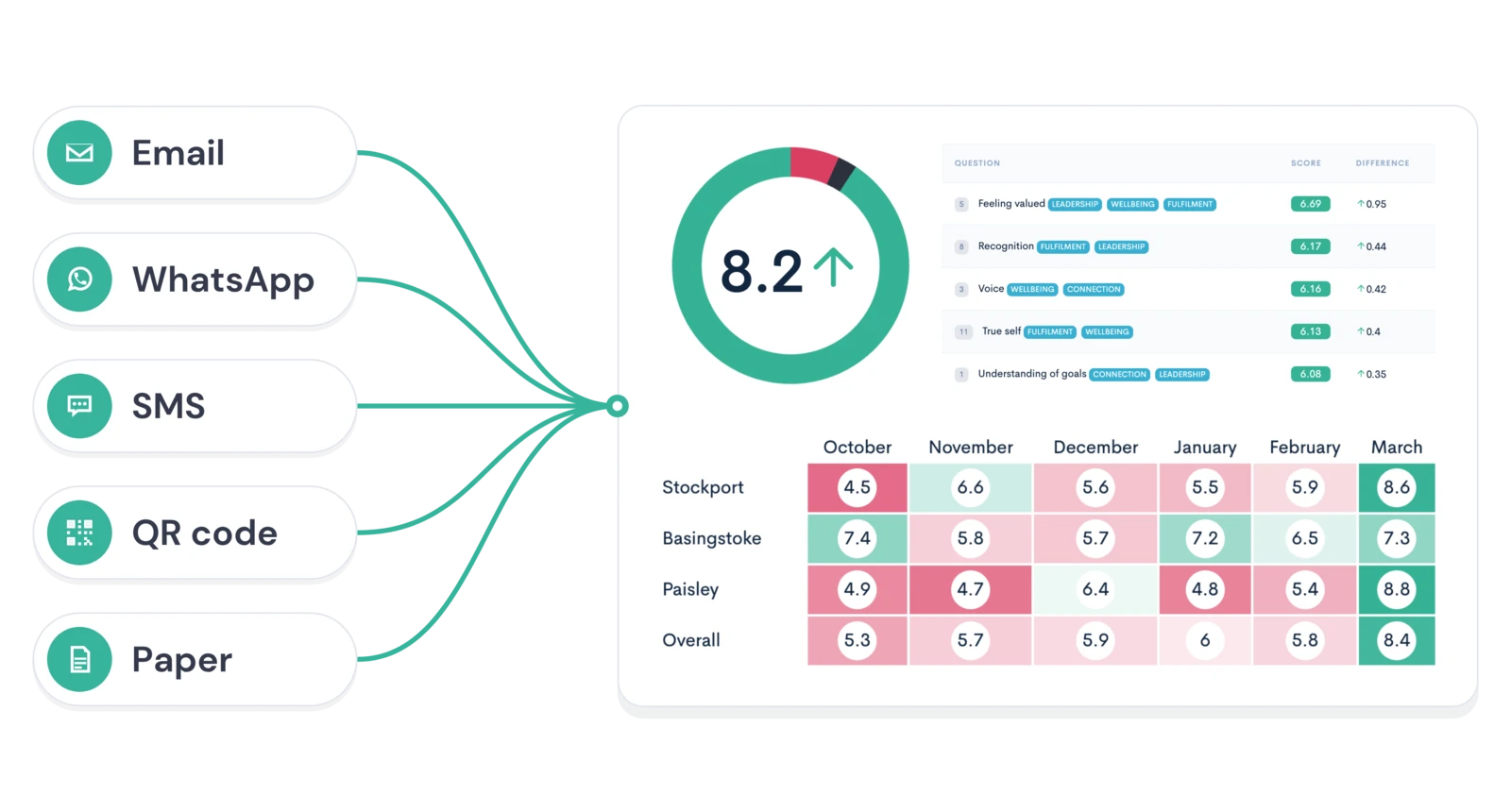
Everyone, including the people who deal with your customers. Ten Space reaches people by email, WhatsApp, SMS, QR code or even paper, with surveys in over 100 languages: with a mobile number, no email address is needed.
See surveys that reach every employee for more.
-
Answers kept to the right people. You choose for each survey. It can be fully anonymous (certain features such as automated reminders and segmentation may not be available); filtered, with our ethics filter, so results are only shown for groups of six or more; or identified, so authorised users can see which individual answered, and people are told before they send any answers. Everyone sees what their role allows, and only that.
- Where the risk is. Every survey can be split by any segmentation item, so you can compare answers by site, team, shift or role, and see where one group's experience of work differs from another's.
- Serious concerns, straight away. An alert can tell a named person, such as your HR director, as soon as an answer needs attention, for example if anybody reports harassment. What they can then see is still set by their role.
-
The trend, and the effect of what you do. Custom dashboards show how answers change over time, so you can spot issues early and see the effect of the steps you take. We work with you to build custom dashboards and reports for you and your leaders.
See custom dashboards for more.
-
Actions that get done. Agree actions with an owner and a due date. Reminders go out automatically, progress is tracked for you, and each action stays linked to the result it came from.
See action planning for more.
We set the platform up for you, and expert help, training and support are always included. Every client has a dedicated client success manager: a named UK-based expert who works alongside your team.
Frequently asked questions
When does the duty to take all reasonable steps come into force?
On 30 October 2026, with the new duty on harassment by third parties. Both were brought into force by regulations made on 1 October 2026. The duty to take reasonable steps to prevent sexual harassment has applied since 26 October 2024.
Will the government say which steps are reasonable?
Probably, but not yet. The Act lets the government set out steps that count as reasonable, such as risk assessments, policies, and steps on reporting and complaints. It will consult first, and expects to make the regulations in 2027/28. Until then, the EHRC's guidance is the best guide to what is expected, and the duty to take all reasonable steps applies from 30 October 2026 either way.
Who does the duty apply to?
Every employer covered by the Equality Act 2010, in England, Scotland and Wales, whatever its size. What counts as reasonable depends on the employer: its size and resources, its sector, its risks and its contact with third parties.
What is third-party harassment?
Harassment of an employee by someone who isn't their employer or a fellow employee, such as a customer, client, patient, contractor or member of the public. From 30 October 2026, an employer that hasn't taken all reasonable steps to prevent it can be held responsible. It covers harassment related to any protected characteristic, as well as sexual harassment.
Should harassment questions in a survey be anonymous?
At least confidential, with answers shown only for groups, as the EHRC recommends. An identified survey lets you follow up with someone who has been harassed, but only if people know before they answer that their name will be seen, and that may stop some of them from answering honestly. Whichever you choose, tell people how to report harassment directly.
How often should we ask about harassment?
As often as suits your organisation. Some organisations run a pulse survey weekly, others monthly or quarterly, and the core statements can go in every one. Ask the fuller set less often, such as every six months, as in the EHRC's example. What matters most is asking regularly, with the same questions.
See how Ten Space pulse surveys hear from everyone, including the people who deal with your customers. Book a 30-minute demo.